Trigonometry
Pythagoras' theorem
In a right-angled triangle, the area of the square on the hypotenuse is equal to sum of the areas of the squares on the two shorter sides.
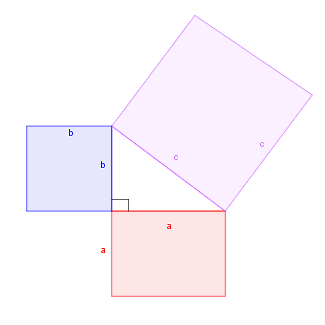
In the above triangle
Square on side a + Square on side b = Square on side c
a^2+b^2=c^2
Trigonometric ratios in a right-angled triangle
With reference to the following following diagram:
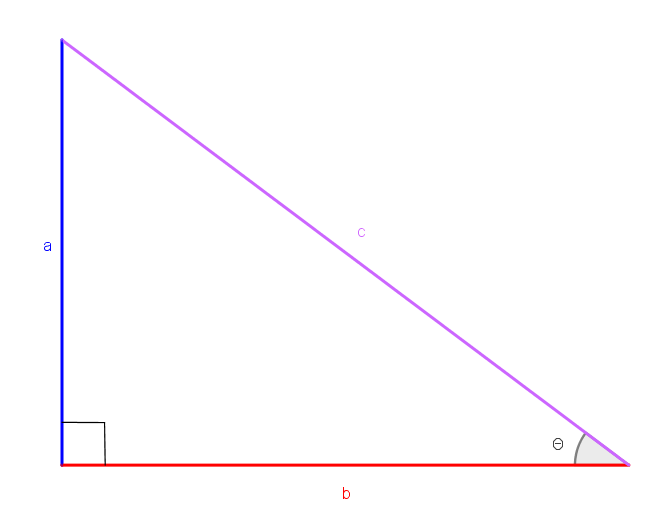
The tangent of the given angle θ is given as
tanθ = oppositeadjacent=ab
The sine of the given angle θ is given as
sinθ=oppositehypotenuse=ac
The cosine of the given angle θ is given as
cosθ=adjacenthypotenuse=bc
Some common angles and their trigonometric ratios
Some trigonometric identities
Triangle formulae
The cosine formula
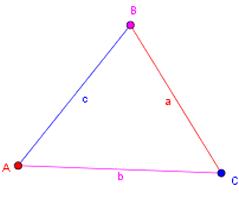
When given three sides of a triangle, as shown below, we can find the angles using the cosine formula
cosAcosBcosC=b2+c2−a22bc=c2+a2−b22ca=a2+b2−c22ab
The sine formula
We can use the sine formula to find a side given two sides and an angle which is not included between the given sides:
asinA=bsinB=csinC
The area of a triangle
In the triangle above, if two sides and an included angle are known, the area of the triangle can be found using the appropriate formula below:
Area=12absinCArea=12bcsinAArea=12casinB
If the angles are unknown and the three sides are known, the area can be determined using the formula
Area=s(s−a)(s−b)(s−c)−−−−−−−−−−−−−−−−−√
where,
s=a+b+c2
The addition formulae
Double angle formulae
Additional Resources
- Trigonometry - a set of pages from mathtutor.ac.uk covering all of the above plus exercises.
- Basic Trigonometry - a Khan Academy video introducing the the trig ratios.
- Basic Trigonometry - another explanation of the trig ratios from mathbff.
- Right Triangles - another video from mathbff explaining how to solve right triangles.