Limits and Continuity
When a sequence of values of a variable $x$ approach nearer and nearer to a fixed value $a$ in such a way that the differences $|x-a|$ becomes and remains as small as we please, the value $a$ is called the limit of the variable $x$.
A variable $x$ is said to have a limit $a$ as $x$ takes on the values $x_1, x_2, x_3, \dots, x_n$ if for every positive number $\epsilon$, however small, the value of $|x_n-a|<\epsilon$ for suitably large $n$. We write $$\lim_{n\to \infty}x_n=a$$
A function $f(x)$ is said to have a limit $b$ as $x$ approaches a value $a$ if for every positive number $\epsilon$, however small there is a value $\delta$ so that $|f(x)-b|<\epsilon$ whenever $|x-a|<\delta$. We write $$\lim_{x\to a}f(x)=b.$$
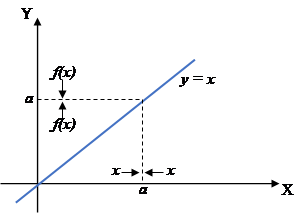
In the above diagram $$\lim_{x\to a}f(x)=a.$$
| $\displaystyle{\lim_{x\to 0}a^x=1},\quad a>0$ |
| $\displaystyle{\lim_{x\to 0}\left(1+x\right)^{1/x}=e}$ |
| $\displaystyle{\lim_{x\to 0}\frac{e^x-1}{x}=1}$ |
| $\displaystyle{\lim_{x\to 0}\frac{\sin x}{x}=1}$ |
| $\displaystyle{\lim_{x\to 0}\frac{1-\cos x}{x}=0}$ |
| $\displaystyle{\lim_{x\to 0}\frac{\tan x}{x}=1}$ |
| $\displaystyle{\lim_{x\to 1}\frac{x-1}{\ln x}=1}$ |
| $\displaystyle{\lim_{x\to \infty}\left(1+\frac{y}{x}\right)^x=e^y}$ |
| $\displaystyle{\lim_{x\to \infty}\frac{a^x-1}{x}=\ln a,\quad a>0}$ |
| $\displaystyle{\lim_{m\to \infty}\frac{a^m}{m!}=0}$ |
| $\displaystyle{\lim_{x\to \infty}\left(1+\frac{1}{x}\right)^x=e}$ |
| $\displaystyle{\lim_{x\to \infty}\frac{x^m}{e^x}=0,\quad \text{for any } m}$ |
| $\displaystyle{\lim_{m\to \infty}\frac{(\ln x)^m}{m}=0}$ |
| $\displaystyle{\lim_{x\to \infty}\frac{\ln )x+1)}{x}=1}$ |
A single valued function, $f(x)$, is continuous at the point $a$ if and only if
- $f(a)$ exists
- $\displaystyle{\lim_{x\to a}f(x)}$ exists
- $\displaystyle{\lim_{x\to a}f(x)}=f(a)$
A single valued function, $f(x)$, is continuous on an interval $(a,b)$ or $[a,b]$ if and only if it is continuous at each point of the interval.
A single valued function, $f(x)$, has a discontinuity of the first kind at the point $x=a$ if the left hand and right hand limit of $f(x)$ at $a$ exist but are not equal. That is if $$\lim_{x\to a^-}f(x)\ne\lim_{x\to a^+}f(x).$$
A single valued function, $f(x)$, is piecewise-continuous on a given interval $(a,b)$ or $[a,b]$ if and only if $f(x)$ is continuous throughout this interval except for a finite number of discontinuities of the first kind.
- Khan Academy Limits and Continuity - a series of videos and quizzes covering the above material.
- AMSI Limits - a document discussing limits at a high school maths level.
- Limits and Continuity - more formal lecture notes covering the material.