Exponential and Logarithmic Functions
| Accordions | ||||||||||||||||||||||
|---|---|---|---|---|---|---|---|---|---|---|---|---|---|---|---|---|---|---|---|---|---|---|
| Exponential function |
If $b$ is any fixed number such that $b>0$ and $b\ne 1$ then an exponential function is a function of the form $$f(x)=b^x$$ where $b$ is called the base and $x$ can be any real number.
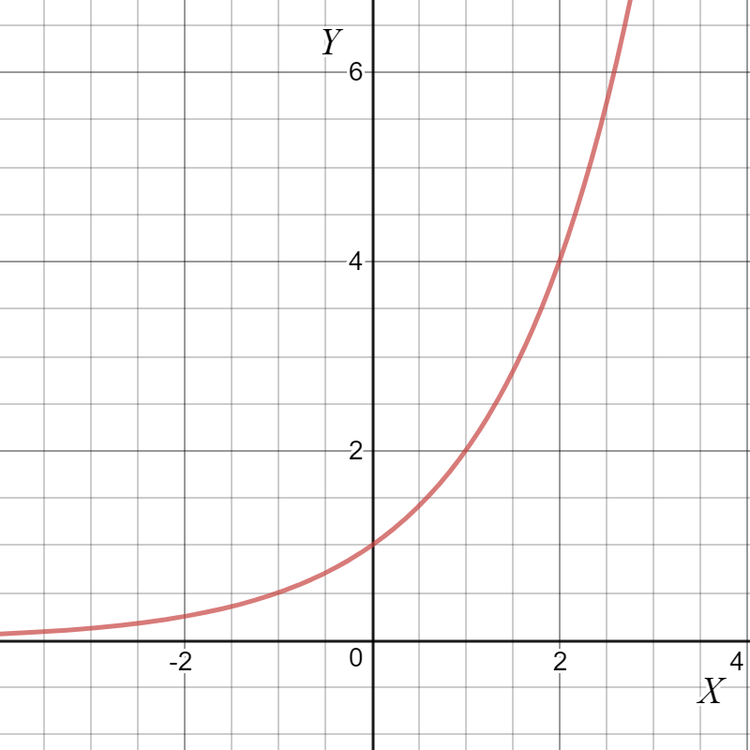
Fig 1: Graph of exponential function The graph of $y=2^x$ is shown in Fig 1. The following common properties of exponential functions can seen from the graph:
An important base used in exponential functions is the base $e$ which is defined by $$e=\lim_{x\to\infty}\left(1+\frac1x\right)^x\approx 2.718281828.$$ $e$ is an irrational number which has important properties in many areas of engineering. |
|||||||||||||||||||||
| Logarithmic function |
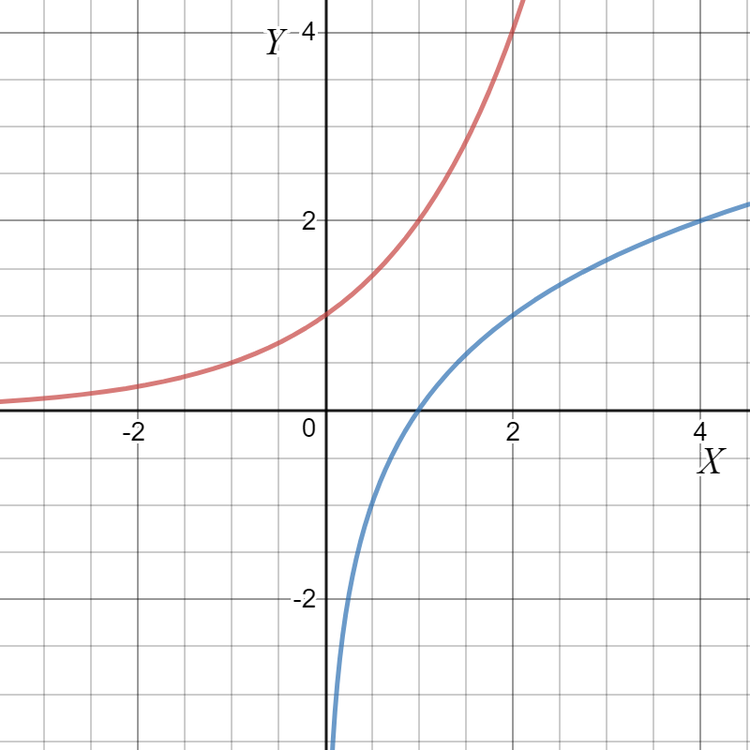
If $b$ is any fixed number such that $b>0$ and $b \ne 1$, and $x > 0$ is any positive real number, then a logarithmic function (with base $b$) is a function of the form $$y=\log_b x$$ which is equivalent to the exponential form $b^y=x$. The inverse of an exponential function is a logarithmic function. The inverse of a function can be thought of as the function obtained by exchanging the $x$ and $y$ coordinates. This reflects the graph about the line $y=x$. As seen from the graph in Fig 2, the logarithmic curve (blue) is the reflection of the exponential curve (red).
Fig 2: Graph of exponential and logarithmic functions |
|||||||||||||||||||||
| Comparison of exponential and logarithmic functions |
|
|||||||||||||||||||||
| Additional resources |
|
|||||||||||||||||||||