What’s Your Research Story – Professor Roger Dean
In “What’s Your Research Story”, we delve into the diverse talents and achievements within MARCS Institute, celebrating milestones and innovation.
This edition, in conjunction with Western Research Week 2024, features Professor Roger Dean, a Professor of Sonic Communication and a distinguished Australian composer, improviser, and performer. His research explores music perception and how meaning (notably affect) is generated. He also applies new cognitive and computational knowledge to develop novel methods for creating music.
Join us as we uncover Roger’s outstanding 50-year research journey, offering insights into interdisciplinary research and invaluable life lessons.
Can you share with us how your journey in research began? What were some early influences or pivotal moments that shaped your decision to pursue a career in academia?
I’m a bit unorthodox: two aspects of my work qualify as research. First, my scientific work within academia, and second, my creative work in music as an improviser/composer. I’ve always run these in parallel, internationally and professionally, since my PhD student days, and I believe strongly that one should try to not let go a major interest one has outside academia.
My academic research was first in biochemistry and was inspired by a dedicated biology teacher in my grammar school in the UK. By about 17, I had developed a moderately obsessive interest in cellular organelles called lysosomes and their role in macromolecule degradation and regulation. This early passion led me to pursue a PhD on lysosomal enzymes and their biosynthesis (how and where they are made, since like everything else, they turn over too). Biochemistry is part of the answer to most medical problems, as well as important in every other organism besides humans.
I guess the decision to aim to become an academic researcher was made at the point I chose the PhD direction I did. I knew that alongside this I could continue to be professional as a musician.
Later in my career, I became deeply involved in music science – musicological, cognitive and computational research on music. While still engaged with biochemistry, I did some early systematic work on improvisation, publishing books on its practice, and its significance across arts. I also explored improvisation’s potential in clinical and organisational psychology. I started using computers for making music as soon as they became accessible on my desk, alongside performing as bassist and pianist.
After directing The Heart Research Institute, Sydney (1988–2002), I made two radical decisions. First, I aimed to become a university leader (Vice-Chancellor), a path I hadn’t previously considered. Second, while in that role, I attempted to make a transition into music research (cognitive and computational), so that both my research and creative focus could eventually be on music. Fortunately, I succeeded in both endeavours: securing an ARC Discovery grant while being Vice-Chancellor at the University of Canberra (2002-2007) and bringing Dr Freya Bailes from England to work with me there and then at MARCS.
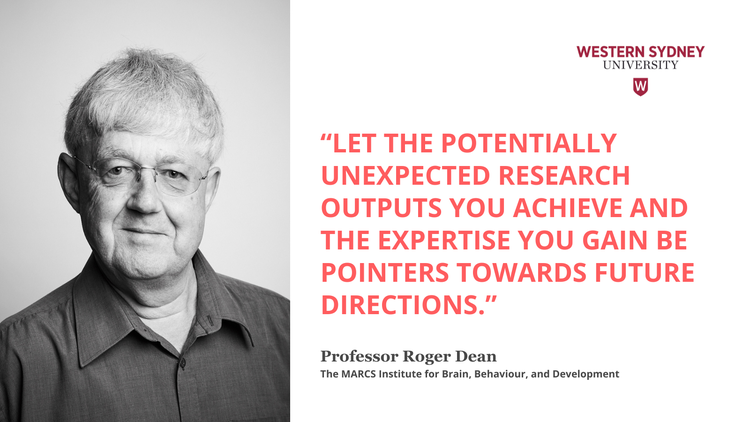
I learnt to always be open to considering new opportunities: let the potentially unexpected research outputs you achieve and the expertise you gain be pointers towards future directions.
Could you highlight one or two of the most memorable projects or discoveries from your career? What made these experiences particularly impactful or rewarding for you?
My biochemical work on controlling lysosomal degradation mechanisms and assessing their quantitative importance was my first exciting output. My main paper on this was published in Nature (1975) and helped to establish me in the field. I had previously met the Nobel Prize winner for the earlier discovery of lysosomes, and quite fearfully given a seminar in his presence. Now, I felt confident enough to engage with him and his team on an equal footing.
In music research, early in my time at The MARCS Institute since 2007, I realised that continuous response studies align with my view of how music works: rather than making the listener feel overall happiness or tension, music evokes a continuous flux of emotions and changing impressions, as reflected in the 2D-emotion space model by James Russell.
I observed that many studies at that time did not take into account time series autocorrelation in music—where past events influence present and future ones—and so they were likely to be misleading. I therefore invested much time in gaining better statistical knowledge, specifically, strong expertise in univariate and multivariate time series analysis. With help from Professor William Dunsmuir at the University of New South Wales (UNSW), I became proficient in these techniques and even received invitations to present my work at statistical conferences.
The initial result was a methodological paper promoting the use of continuous response methods in studying music. Subsequently, we conducted several detailed studies confirming that changes in sound intensity play a crucial role in how people perceive both the energy (arousal) and emotional tone (liking) of music. Additionally, we uncovered numerous other subtle factors influencing these perceptions.
I particularly enjoyed the fact that along the way, I realised that our acoustic intensity observation could permit a causal intervention experiment, where with little else changed, the acoustic intensity temporal profile of several pieces was inverted, with the predicted effect on the trajectory of perceived arousal expressed by the piece.
This ‘fun’ experiment was designed and executed in collaboration with Drs Freya Bailes (currently at University of Leeds, UK) and Emery Schubert, UNSW. I found that success rewarding and enthusing, and I continue to use time series approaches, including the Bayesian versions.
With your wealth of experience, what advice would you give to young researchers who are just starting their careers in academia? Are there specific principles or strategies that have guided you and that you would recommend to others?
I’d say to follow your enthusiasm, questioning and seeking the strongest possible experimental outcome, even if time consuming. It took me a long while to become competent in time series analysis, but it continues to be a good investment.
At the same time, for an early career researcher in our increasingly challenging research environment, maintaining a steady flow of good, published work is crucial, starting from the PhD years. Having the self-control to balance safe and risky approaches is vital. Perhaps later in a career, one can afford to take more risks.
My other key thought is to be open to opportunity that you might not have anticipated. During my second post-doc, I became concerned about my extremely well-endowed research environment, because it lacked a clear path to forming my own research group. It took a US collaborative visitor and continuing friend to encourage me to apply for a Readership (a research-intensive Associate Professorship) in a technological university to achieve my goal. Again, I was lucky, and had a great decade at Brunel University in London.
It's 50 years since my PhD was conferred, and I continue to enjoy research as much as ever. However, not everyone does, and my enthusiasm might be enhanced by my significant career move in 2007 from biochemistry to music science. My advice would be to consider whether your research enthusiasm matches the huge effort and the inevitable repeated rejections or failures (small or large): if not, look at other niches. There are so many fields in which a trained scientific/research mind is essential and prized.
In the short video interview below, Professor Roger Dean shares his views on the impact of music science in the next decade.