Sandy Edwards: A Backward Glance at Australian Feminism
Exhibition Details
Date: 5 June to 22 August 2025
Venue: Institute for Australian and Asian Arts and Culture, Building EA, Parramatta South Campus, Western Sydney University
171 Victoria Road, Rydalmere
Gallery Opening Hours: Monday – Friday (9:30am – 5:00pm)
Contact: lindsay.liu@westernsydney.edu.au
E-Catalogue
The Institute for Australian and Asian Arts and Culture is honoured to present this very compelling exhibition showcasing selected photographic works by Sandy Edwards, a key figure in Australian photography. Emerging in the 1970s and 1980s, Sandy Edwards was instrumental in the feminist photography movement, using her documentary style to challenge traditional narratives, highlight issues of gender and identity, and question societal norms. Her work not only documents social conditions but also serves as a catalyst for dialogue and change, reflecting a profound commitment to feminist ideals.
Sandy Edwards: Looking Ambiguously
Shaune Lakin, Senior Curator, Photography, National Gallery of Australia
The object of desire adorns herself with the greatest care and offers herself a motionless figure to the temptation of a possessor … it must no longer exist for itself but for the other’s desire.
– Georges Bataille, 1976/1949[1]
In a world ordered by sexual imbalance, pleasure in looking has been split between active/male and passive/female. The determining male gaze projects its phantasy onto the female figure, which is styled accordingly. In their traditional exhibitionist role women are simultaneously looked at and displayed, with their appearance coded for strong visual and erotic impact.
– Laura Mulvey, 1975[2]
The politically dissident photographer … is involved in an apparent paradox, that of seeking to penetrate appearances with an instrument designed specifically to record appearances and appearances alone.
– Victor Burgin, 1975[3]
I realise the use of three epigrams seems gratuitous for a short introduction to this long-overdue survey of Sandy Edwards’ photographs from the 1970s and 1980s.
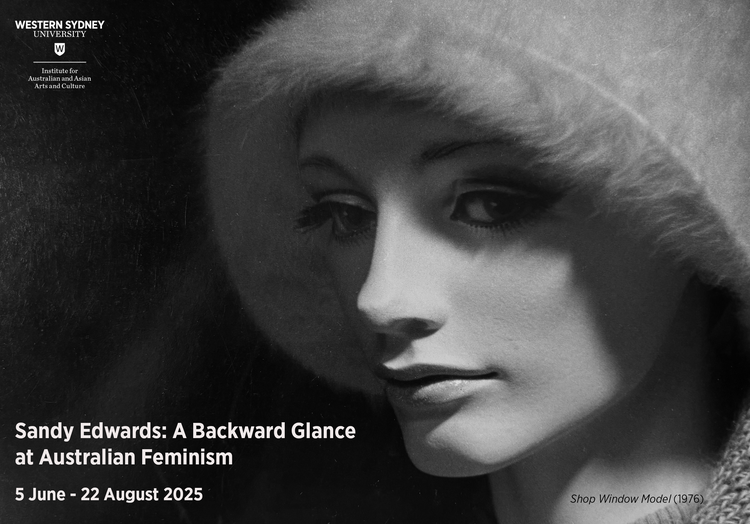
But I am struck by the coincidence of the publication of these statements (each of which either itself has become ‘canonical’ or comes from a text that is central to the literature of feminist revisions of the logic of looking and being seen) and Sandy’s earliest critical work. By this I mean the expansive group of photographs she initiated in 1975, some of the threads of which were carried through to the 1980s: the grabs she made at home while watching on television women in classical cinema; her photographs appropriating images of women in advertising; the images of mannequins based on the David Jones shop windows she admired in Gadigal Nura/Sydney.
At first glance, it might look like Sandy’s photographs from this time are illustrations of the then-widely discussed ideological issues reflected in Bataille’s, Mulvey’s and Burgin’s statements. Sandy’s photographs were arranged in groups that drew attention to repetition of gesture and mood, resonating with the ways that artists like James Welling and Suzy Lake were at the same time drawing on the history of the readymade and images from mass media to highlight the ways that stereotypes of gender and power relations are produced through our everyday encounters with images. So too did Sandy’s photographs. When they were exhibited at Hogarth Gallery and at the University of Sydney in 1976, Sandy’s images of movie stars and David Jones mannequins, photographs that all shared the same dramatic tonal contrasts, expressions, and points of view, demonstrated how ‘woman’ is cast pictorially as an object of desire, how she performs this role, and the instrumental role of the camera in processes of identification and performativity. The photographs showed how the privilege of looking is gendered, and that the camera (whether a motion picture camera or an SLR) is bound to this.
But rather than simply restaging this binary logic, Sandy’s work has always sought to renegotiate it. Her work with the activist collective Blatant Image, which from 1979 made photographs that directly challenged representations of gender and social relations, sought ‘a more critical attitude towards photography.’[4] By inhabiting the divergent spaces within which photography has been used to engender identity and power relations (advertising, photojournalism, social documentary, activism, snapshot and family photography), Blatant Image sought to carve out places for women to draw on the ideological language and structures of photography to make ‘new images’ of and for women.[1]
In another way, Sandy’s photographs have slipped around the binary logic of looking through their basis in pleasure and subjectivity. Her reflections on the making of her photographs of models and actors capture a complex ambiguity that reflects, simultaneously, critical interrogation and a subjective experience that includes pleasure and fandom. Sandy’s memories of making photographs of Hollywood stars while watching television are loaded with a network of feelings and associations, including watching movies at night as a child with her father. These photographs are not simply studies of representation at work: ‘I started photographing these films as they played. Then I would print the images in the darkroom sometimes juxtaposing two or even three images onto the paper as a narrative sequence. I would choose moments that meant something to me, moments of emotion and romance.’ In a similar way, the photographs of mannequins remember the ambivalent pleasure of looking at David Jones’ shop windows at night, ‘mesmerised by the effects of the lighting on the models in the windows. It created a stage.’[2]
The photographs betray the ambiguity of looking: sight is cognitive and sensual (loaded with desire and memory), setting up a photographic positionality that would give to all of Sandy’s work, even as it moved more explicitly into spaces of economic and social relations, a subjective substance that can move you without being sentimental. Her widely collected series Sugar in the morning 1978, showing a woman packing sugar cubes at the CSR sugar refinery plant at Pyrmont, brings this positionality directly into contact with the documentary mode. With their frontality, serialism and printed black edges (indicating a full frame; no cropping), they suggest in form and style the highly loaded, ‘neutral’ practices of documentary and reportage.
But in place of the pathos, didacticism and fixed subject/object relations that have historically accompanied the documentary mode’s engagement with labour, Sandy photographs an extended (and very specific) moment of inter-subjective connection. The woman at work laughs at or with her, at one point pausing with her arm on a metal frame. Seemingly at once resting and expressing impatience with being looked at, the woman and, in turn, Sandy found their way through the paradox of photography’s regulation of power. The photographs point towards, to use Sandy’s own terms, ‘a form of intimacy’ that, remarkably I think, we can still feel.
[1] Georges Bataille, ‘The object of desire’, The accursed share (1976/1949), vols II and III, trans, Robert Hurley (New York City, USA: Zone Books, 1991) pp 139, 143
[2] Laura Mulvey, ‘Visual pleasure and narrative cinema’, Screen 16.3 (Autumn 1975) p. 11
[3] Victor Burgin, ‘Art, common sense and photography’ (1975), in The camera: Essence and apparatus (London, England: MACK, 2018) p. 20
[4] Sandy Edwards, on behalf of Sandy Edwards, Helen Grace, Victoria Middleton, Lisa Sharkey and Karen Turner, ‘Blatant image’ in Kurt Brereton ed, Photo-discourse: Critical thought & practice in photography (Gadigal Nura/Sydney: Sydney College of the Arts, 1981) p. 69
[5] Sandy Edwards, on behalf of Sandy Edwards, Helen Grace, Victoria Middleton, Lisa Sharkey and Karen Turner, ‘Blatant image’ p. 68
[6] Sandy Edwards, email to author, 11 May 2025
About the Artist
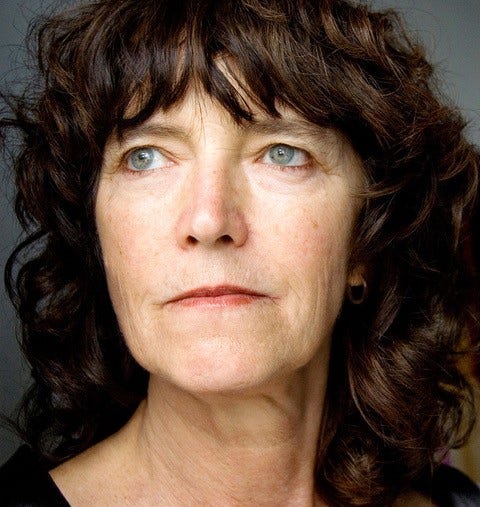
Sandy Edwards is a prominent Australian photographer and curator renowned for her deeply personal approach to documentary photography, focusing on the portrayal of women and Aboriginal communities. After moving to Sydney from New Zealand in 1961, she received a BA in psychology from the University of Sydney in 1969 and later studied film at the Slade School of Fine Art in London from 1972 to 1973. Throughout the 1980s, she taught photography at Tin Sheds, the Sydney University Art Workshop.
In the 1970s and 1980s, Sandy emerged as a leading figure among progressive photographers dedicated to documenting social conditions with the intent to inspire change. Her work often draws from feminist ideals, critically examining media representations of women and exploring the portrayal of Aboriginal communities in Australia. Her sensitive and evocative photographs are taken with an intuitive response to feelings, people and place. She broadens the genre of portraiture to explore inter-relational themes such as trust, love and community.
Sandy was a founding member of the feminist photography collective "Blatant Image," established in 1979, alongside Helen Grace, Victoria Middleton, and Lyn Silverman. Together, they created photographic works that analysed and contrasted media representations of women.
Sandy has had many solo and group exhibitions in key Australian institutions, including the Art Gallery of New South Wales, the National Gallery of Australia, Queensland Art Gallery, Newcastle Art Gallery, as well as Sydney Writers Festival and Adelaide Festival. Her photographs are held in major collections such as the National Gallery of Australia, Art Gallery of New South Wales, Parliament House, and Monash Gallery of Art.
Beyond her photographic practice, Sandy has significantly contributed to the art community as a curator and mentor. She served as co-director and curator of Stills Gallery in Sydney from 1991 until its closure in 2017, one of Australia's foremost photographic galleries. In 2008, she founded Arthere, a new gallery model that provided services to photographers - consultation, mentoring, curating, exhibition production. Arthere has produced over 100 exhibitions.
Sandy's works continue to influence and inspire discussions around gender, identity, and community within the realm of documentary photography.
Artist Statement
The primary subject of this exhibition is how feminism, which emerged in Australia in the mid-1970s, changed the way women could act and think in the world. It was a very exciting time. Feminism taught me that life did not need to live up to a formula of getting married and having children. Women were taking action to restage their lives by proactively carving out their careers, rejecting conservativism, and actively fighting for social change. I identified with my peer group as I watched them making important choices in their lives, especially in their relationships. Some of the questions were whether to get married, what your sexual identification was, what kind of career you forged. The aim is to expose the cultural gender roles of the time by querying and challenging the standard role which women were expected to adopt.
I had a passion for cinema, watching movies both in the cinema and on TV, where, in regular program slots, a good range of classic films such as Casablanca (1942) and Sunset Boulevard (1950) were shown. I analysed the male and female roles of those earlier times. I was fascinated that the faces of the women stars were lit differently from the male stars. I photographed the scenes which showed women looking beguilingly into men’s eyes. It seemed to say there is no other option in life than marriage.
I collected images from women’s magazines, editorial fashion spreads, advertisements promoting how to be more beautiful, sexy, and bold. I took photographs of my friends. We dressed ourselves in different styles for the camera, always looking strong, playing out roles in opposition to the standard beautification of women, but also allowing ourselves to be sexy if we wanted. A group of us formed a group called “Blatant Image.” We practised ‘actions’ and photographed ourselves in ways we wanted. Role reversals were another practice. We plagiarised Playboy images making the man the object of sexualisation instead of the woman.
Being a female photographer was a rarity in those days. I definitely benefited from my associations with Sydney women filmmakers, whose films I was invited to be stills photographers on. Filmmakers like Martha Ansara, Margo Nash, and Gillian Leahy were ground breakers of that time.
When CSR photographic project came up in 1978, I was selected along with photographers Mark Johnson, Graham McCarter, Micky Allen, and others. I had my focus on women workers who were all migrant workers packing sugar cubes. They looked out for each other in a situation of hard physical coordination work.
My interest in Indigenous issues was awakened much more deeply when I was offered a commission by the Australian Institute of Aboriginal and Torres Strait Islander Studies (AIATSIS) to go to Brewarrina in western NSW. This was a project which was to reflect what was happening on the ground for Indigenous communities at the time of the Bicentennial in 1988. I held an exhibition at the Tin Sheds Gallery at Sydney University, which provided a much wider picture of what life in Brewarrina was for the majority Indigenous community there. As a result of that exhibition, I was invited to work on Murawina: Aboriginal Women of High Achievement (1993), which photographed and told stories of thirty-two Indigenous women of high achievement all around Australia.
“Taking A Nap” is one of the chapters from A Narrative with Sexual Overtones, which was curated as part of Virginia Coventry’s exhibition at First Draft in 1983. It embraced the entirety of all the previous work I had done on these feminist subject matters. In “Taking A Nap”, women are portrayed as being ‘laid down’ to appear sexually available. They are drawn from fashion spreads in women’s magazines.
The majority of photographs in this exhibition were taken and printed in the 1970s through the 1980s, with the last series in 1993. They are in original condition, some showing a little aging, yet the tones of the silver gelatin prints are in perfect black and white condition.
About the Exhibition
This exhibition features a selection of Sandy Edwards’ works from the 1970s, 1980s, and 1990s, serving as a snapshot of Australian feminism. The works are divided into nine sections: Shop Window Models (1976); Women on Television Screen (1960s and 1970s); Women and Advertising (1976); CSR Sugar Refinery Project (1978); Women Filmmakers (1977 - 1983); Friends’ Role Play (1970s); Photos of Sandy Edwards by Michael Snelling (1980s–1999); Taking a Nap from A Narrative with Sexual Overtones (1983); and Murawina: Australian Women of High Achievement (1993).
Exhibition Opening
The Exhibition was officially opened on 11 June 2025. Dr Nicolene Murdoch, Pro Vice-Chancellor for Global, delivered an opening speech in which she shared a beautifully moving story about her sister Antoinette Murdoch, a renowned artist in South Africa and Chief Curator of the Johannesburg Art Gallery. Nicolene showed her sister’s iconic work titled "Rokke" series—seven wedding dresses crafted from Kleenex tissues. The series critiqued societal expectations of women and the fragility of traditional roles. These dresses, delicate yet conceptually robust, challenged conventional feminist narratives by intertwining personal experience with broader cultural commentary. Antoinette Murdoch’s “Rokke” series, just as Sandy Edwards’ selected photographic works in the exhibition, demonstrates how feminism, through the lens of art, speaks to us all, regardless where we are from, what our cultural backgrounds are and what languages we speak. Art has a boundless power, the power to influence and the power to connect. The full speech can be accessed HERE
Exhibitions
- Connecting and Connections
- Owen Leong: Bitten Peach 分桃
- Portraits of Women: Amani Haydar
- Hidden Treasures Virtual Gallery
- History Reimagined: Shen Jiawei and NC Qin
- Individual and Universal: the World We Share
- Warren Duncan Exhibition: Australians in 1970’s China
- Traditions & Transformations
- Geng Xue Solo Exhibition 2
- Red Heart of Australia
- William Yang Exhibition: Claiming Heritage
- Wang Lan's Art: A Lyrical Language 牧歌
- Exhibitions 2022
- Exhibitions 2021
- Exhibitions 2020
- Exhibitions 2019
- Exhibitions 2018
- Exhibitions 2016-2017