Supporting Healthy Bees And Healthy Crops - Hort Frontiers Pollination Fund
Last Updated: 3 years ago
Shortlink to this page: http://bit.ly/2gM358m
Take part in our Decadal Australian Stingless Beekeeping Research Survey
Our Australian stingless bee industry is growing rapidly! To keep a check on the growth, we do a survey every ten years. So far, we have seen a 114% increase in the number of beekeepers between 1999 and 2010. This increase is close to what had been predicted. We hope to continue growing to meet these expectations and keep the Australian stingless bee community buzzing. Any guesses on how large is the Australian stingless bee industry now in 2019? We need your help to find out! The information from this survey will help support research on stingless bees, which would help in the growth of the industry.
We don’t want this to be just another survey you take and get nothing in return. Everyone who participates will have a chance to win a ‘The Australian Native Bee Book by Tim Heard’ or Gina Cranson Native bee poster or a membership to a beekeeper’s club (winners could pick one of the three choices).
Complete the survey here (opens in a new window)
We are far more reliant on pollinators than most people realise - many of our food crops rely on pollination by insects or other organisms and even producing seed to grow new crops usually requires insect pollinators. Much of the hard work of pollinating flowers is done for us for free by European honeybees (Apis mellifera) but Australia also has a wide range of native stingless bees that pollinate flowers.
Across the world, honeybees are being affected by an invasive mite called Varroa that can kill whole colonies. If this mite becomes established in Australia, honeybees may suffer serious declines and that could cause significant problems for farmers, consumers and many other industries.
This project aims to explore opportunities to protect native bees and honeybees by better understanding which ones contribute to different crops' pollination, and to develop ways to better provide pollinating insects with the right food sources to thrive under different crops and in different seasons.
This includes:
- understanding which insects actually do the work of pollinating different types of flowers and crops. For example, research on avocadoes showed that flies do most of the pollination, not honeybees (source (opens in a new window)).
- understanding the different non-crop food sources available to honeybees, stingless bees, flies, hoverflies and many other pollinators in Australian horticultural contexts
- assessing which diseases affect different pollinators and whether there is any chance that diseases can pass from one pollinator type to another - for example from stingless bees to honeybees
The $7 million five-year program will be delivered by some of the country's top researchers from Western Sydney University, Bayer CropScience, Syngenta Asia-Pacific and Greening Australia, and executed with support from Hort Innovation through its strategic co-investment Pollination Fund.
The research will focus on:
- Characterising and securing alternative pollinators: Reducing the dependence on honey bees by identifying the roles of different insect pollinators in the pollination of key horticultural crops in field situations.
- Increasing pollen and nectar on farms: Developing an understanding of the contribution of floral resource species to bee colony and population health, and devise farm-level floral enhancement schemes.
- The effects of climate change on pollinators: Testing how climate manipulations influence the timing, quality and quantity of nectar and pollen available to bees.
- Bee virus research: Determining what viruses are harboured by native bees and to what extent these are shared by honeybees and native bees.
- Protected cropping pollination: whether stingless native bees or other organisms can be used inside glasshouses or enclosed cropping conditions to perform pollination effectively and reduce pollination labour costs.
- Grower involvement and adoption: Informing and educating growers and land managers about bee population health – floral resources, diseases, soil and pest management.
Our research in the National Vegetable Protected Cropping Centre Glasshouse (opens in a new window) found that native stingless bees (Tetragonula carbonaria) were able to acclimatise and successfully pollinate strawberries in the fully-enclosed glasshouse bays, indicating their potential as an option for crop pollination.
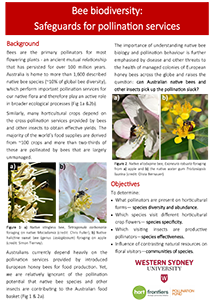
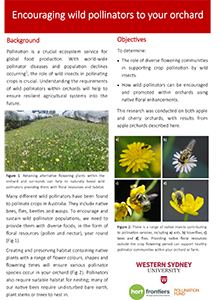
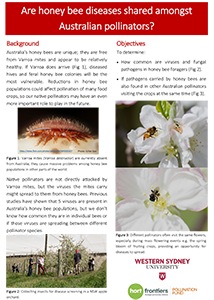
Research Summary Factsheets
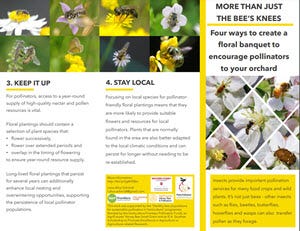
Floral Planting Brochure
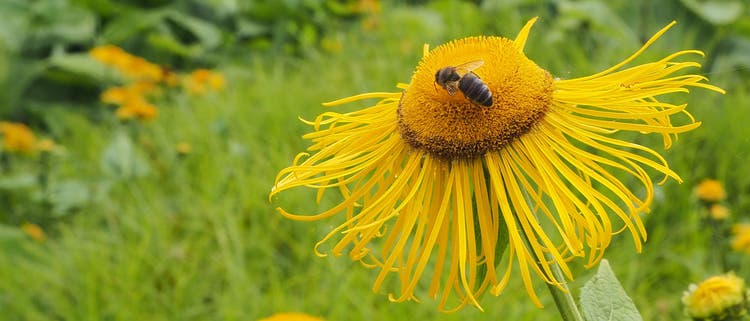
There are many types of pollinating insects other than European honeybees and this research aims to understand their roles in pollination in much more detail. Image credit: Prof James Cook.
For more information contact Prof James Cook on james.cook@westernsydney.edu.au.
Partners


"Stingless bees as effective managed pollinators for Australian horticulture" is funded by the Hort Frontiers Pollination Fund, part of the Hort Frontiers strategic partnership initiative developed by Hort Innovation, with co-investment from Western Sydney University, Bayer CropScience, Syngenta Asia-Pacific and Greening Australia, and contributions from the Australian Government.