Advancing Long-Term Ecological Monitoring in the Greater Blue Mountains
Western Sydney University’s Blue Mountains Hub for Ecology and Conservation has made substantial progress in establishing a long-term, integrated ecological monitoring network across one of Australia’s most significant and vulnerable landscapes. Developed in partnership with the Terrestrial Ecosystem Research Network (TERN) and technology partner Edaphic Scientific, the Hub is laying the foundations for a research platform that will support ecological science, conservation management, and environmental decision-making for decades to come.
Over the past year, the Hub has completed field surveys for 35 permanent ecological monitoring plots extending from the Cumberland Plain, across the Greater Blue Mountains World Heritage Area, and into the Central West of New South Wales. This 165-kilometre transect spans a broad range of elevation, climate, and vegetation types, capturing major environmental gradients in temperature and rainfall. The resulting plot network provides a robust framework for understanding how ecosystems respond to pressures such as climate change, drought, fire, and urban expansion at Sydney’s western edge.
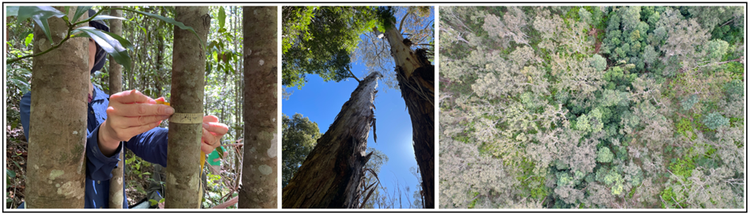
Each plot has been established using a standardised design to ensure long-term consistency and compatibility with national and international monitoring programs. Within 30-metre diameter plots, all trees greater than or equal to 10 centimetres in diameter have been measured, tagged, and mapped, creating a permanent record of forest structure and composition. Larger, overlaid survey areas support monitoring of fauna, enabling integrated assessments of vegetation and biodiversity across dry sclerophyll forest, wet sclerophyll forest, and rainforest communities.
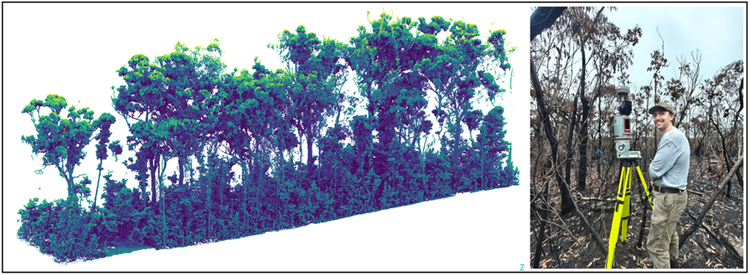
A major milestone for the Hub has been the completion of terrestrial LiDAR scanning (TLS) across 35 plots. These surveys were led by Professor Kim Calders in collaboration with the SpaceTwin team, including Zane Cooper, Wout Cherlet, and Wouter Van den Broeck (Ghent University). The high-resolution three-dimensional scans provide unprecedented detail on forest structure, enabling precise estimates of biomass, carbon storage, and structural complexity. The terrestrial LiDAR datasets are being complemented by aerial LiDAR surveys using unmanned aerial vehicles, allowing forest structure to be scaled from individual plots to the surrounding landscape. Together, these approaches position the Hub at the forefront of forest monitoring and ecological remote sensing in Australia.
In parallel with plot establishment and scanning, the Hub has begun deploying a new smart sensor network, consisting of a generation of automated environmental sensors designed to collect continuous, real-time data on ecosystem processes. Demonstration deployments have been established to test plant-based sensors that measure tree water use, growth, and physiological stress at high temporal resolution. These systems provide insights into ecosystem dynamics that are not possible through traditional, manually collected measurements.
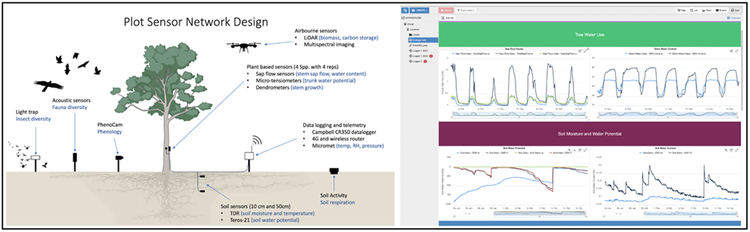
The first fully instrumented site has now been established at the TERN Cumberland Plain SuperSite. This site integrates plant, soil, microclimate, and biodiversity sensors into a single, coordinated monitoring platform. Measurements of sap flow, trunk water potential, stem growth, soil moisture, soil water potential, and atmospheric conditions are combined with phenocams, camera traps, acoustic recorders, and automated insect monitoring. Data are transmitted via telemetry to cloud-based systems, creating a real-time stream of ecological information that will underpin research, forecasting, and management applications.
Beyond its research outcomes, the Blue Mountains Ecology Hub is also serving as a platform for education and capacity building. The plot network and sensor systems provide hands-on training opportunities for undergraduate students, higher degree researchers, and early-career scientists, equipping them with practical skills in field ecology, remote sensing, and environmental data science.
By investing in permanent plots, advanced sensing technologies, and long-term partnerships, the Blue Mountains Hub for Ecology and Conservation is creating an enduring research asset. As datasets accumulate over time, their value will continue to grow, strengthening Western Sydney University’s role as a trusted leader in ecological science and conservation across one of Australia’s most iconic landscapes.
Researchers, land managers, and community partners interested in learning more about the Blue Mountains Hub for Ecology and Conservation, or in exploring opportunities for collaboration, are encouraged to get in contact with the project team at Western Sydney University - contact Brendan Choat (b.choat@westernsydney.edu.au). The Hub welcomes partnerships that strengthen long-term ecological monitoring, research translation, and conservation outcomes across the Greater Blue Mountains region.