The New Colombo Plan Mobility Program

|
The NCP's strategic objective is to enhance Australia’s regional influence by cultivating a diverse group of Australian alumni with in-depth knowledge, skills, and connections in the Indo-Pacific region. The NCP seeks to boost Indo-Pacific understanding in Australia by enabling university students to study and intern in the region.
The NCP offers two programmes: scholarships (up to 19 months) and mobility grants (4 weeks to 2 semesters). Both include study, internships, mentorships, and language training. Additionally, the NCP Alumni Programme supports graduates in maintaining connections with each other, the NCP, and the Indo-Pacific as they progress in their careers.
The NCP aims to achieve:
- A larger, more diverse pool of Australian graduates with Indo-Pacific expertise.
- Stronger people-to-people and institutional ties between Australia and the Indo-Pacific.
- Connections for students and alumni with leaders in government, business, and civil society in the Indo-Pacific.
2025 NCP Reforms
Several reforms will be introduced from 2025:
- A shift towards long-term study immersions, extending the minimum mobility project duration from two to four weeks.*
- A new language stream focused on intensive language training to enhance Australia's Asia literacy.
- Increased prioritisation of partnerships with institutions in the Pacific to strengthen regional connections.
*If you find that the restrictions associated with NCP funding no longer align with your interests, please consider exploring Supplementary or Alternative Finance options or Affordable 4-Week Programs in the Indo-Pacific.
.
Priority Areas for Selection
Priority will be given to projects that enhance Australia’s capability in Asian languages, immersive experiences, and lasting regional partnerships, particularly those that:
- Focus on studying a language other than English (creating a language stream for mobility students).
- Involve long-term immersive experiences in the Indo-Pacific (a full semester or longer).
- Are developed in partnership with Indo-Pacific host institutions, especially those involving collaborative research, Pacific engagement, and other Australian Government priority areas.
Grants Available
A total of $43.2 million is allocated for NCP grant funding in the 2024-25 financial year, covering both the NCP Scholarship Programme and the Mobility Programme.
Grant Period
Mobility projects must last a minimum of 28 continuous days, from departure to return. The maximum duration is two consecutive semesters. All participating students must return to Australia by the end of the programme, no later than 31 December 2026.
Student Eligibility
To be eligible for a student grant, each student must:
-
Be an Australian citizen.
-
Not hold citizenship or permanent residency in the proposed host location while participating.
-
Be enrolled in an undergraduate course at an Australian onshore campus during the project.
-
Receive credit for the mobility project towards their course completion at an Australian university.
-
Be at least 18 years old and meet age requirements.
-
Not:
- Receive more than one NCP student grant for the same project.
- Receive more than two NCP student grants during their undergraduate studies.
- Participate in another offshore scholarship or mobility project concurrently, unless approved by DFAT.
-
Agree to comply with DFAT’s Child Protection and Preventing Sexual Exploitation, Abuse, and Harassment Policies, including reporting obligations, and complete the NCP pre-departure training modules.
-
Sign an acknowledgement of the NCP Student Code of Conduct before departure.
-
Consider the Guidelines to Counter Foreign Interference in the Australian University Sector.
Age Requirements
Ensure at least 70% of students participating in a mobility project and receiving a grant are aged between 18 and 28 at the project's start. Aboriginal and/or Torres Strait Islander students are exempt from this age range but will be counted as under 28 for the purpose of meeting the 70% requirement, acknowledging that many are mature-aged students.
Eligible Grant Activities
NCP Mobility Programme funding is restricted to student grants and administrative costs for approved mobility projects. Australian universities can apply for funding for projects that:
-
Include at least one of the following components:
- Research
- Study
- In-country face-to-face language study
- Internships (including clinical placements, practicums, or artist residencies)
-
Provide credit or contribute to the completion requirements of the student's undergraduate course.
-
Are undertaken in an eligible host location.
-
Are not conducted at an offshore campus of an Australian university or a university headquartered outside the host location, unless approved by DFAT.
-
Do not violate DFAT’s Safeguard Principles.
For projects involving scientific exchange or research, institutions should be aware of Australia’s export control regimes. The Guidelines to Counter Foreign Interference in the Australian University Sector should be applied according to the risk level at each institution.
Student Grants
Eligible students participating in a mobility project will receive a grant to help cover international travel and in-country living expenses. In your application, you must justify the proposed per-student funding, including a draft budget, ensuring the grant reflects actual costs at each location. Suggested grant amounts are:
- Up to $4,000 for projects lasting at least 4 weeks.
- Up to $5,000 for projects lasting at least 6 weeks.
- Up to $10,000 for projects lasting at least one semester.
- Up to $20,000 for projects lasting two consecutive semesters.
Grant amounts may vary based on host location costs, project nature, and additional expenses (e.g., travel for remote students or accessibility for students with disabilities). Students participating in similar projects should receive equal grants unless additional costs are justified, such as extra travel expenses.
You may provide higher grants for students with additional travel costs, and you can arrange group travel using grant funds if it benefits students, with their written consent. For grants of $5,000 or more, payment can be made in tranches.
Grant funding must not be used for administration costs. Apply for a realistic number of grants based on what you can deliver within the 2025 project term, considering any unused grants from previous rounds. DFAT may offer less funding than requested, depending on the university's past performance in utilising previous NCP funding rounds.
Administration Funding
Recipients of NCP mobility funding will receive administration funding equal to 10% of the total student grants for the project. This funding can only be used for managing NCP mobility projects, including:
- Supporting increased participation of diverse students.
- Enhancing the quality of mobility experiences, such as through risk management and critical incident planning.
- Planning, arranging, and negotiating the mobility project.
- Supervising, monitoring, and evaluating students’ progress (excluding core staff salaries).
- Engaging third-party providers with expertise and systems to support students during the project.
5% of the admin funding is retained by the International Office to employ a staff member responsible for overseeing the project's implementation, including the tasks outlined above—see the Guidelines).
Unspent administration funding must be returned to DFAT, along with any unspent mobility grant funds, upon project completion and financial acquittal. If no student grants were used, all administration funding must be returned. If only some students travelled, you may retain administration funding equal to 10% of the grants paid to those students. In cases where no students travelled due to extenuating circumstances, DFAT may allow retention of up to 10% of the offered grant funding, if justified.
Mobility Partnerships
We encourage the development of mobility partnerships with organisations in Australia and the region to enhance opportunities for NCP-funded students and institutions. These partnerships can help build connections and create lasting relationships that align with the NCP's objectives. Examples include:
- Financial sponsorship from private sector organisations.
- Language training provided by community language schools in Australia, either before or after travel.
- In-kind sponsorship, such as free goods or services for the mobility project that would otherwise incur costs, like access to resources or learning and development opportunities.
Mobility partnerships should support the NCP's strategic goals and must exclude contributions from Australian universities, host institutions, or service providers paid for supporting the mobility project.
During the application process, applicants must provide a letter from the proposed host organisation indicating their approval in principle to host the project.
Eligible Host Locations
Mobility projects must be conducted in one of the following host locations:
|
|
|
The primary host location is where the majority of the mobility project must take place, as this is the location for which the project is awarded.
Secondary Host Location
Certain components of the project may occur in a secondary host location. Examples include:
- Conducting research in a primary host location and fieldwork in a secondary location.
- Combining a study programme in the primary host location with an internship in a secondary location.
The inclusion of a secondary host location must be justified in the application.
Travel Requirements
Student travel for the proposed project must begin by 31 January 2026. If travel is not planned to start by this date, you should not apply in the 2025 round but may consider applying in a later round of the programme.
Assessment Criteria
Your application must include detailed input in the Project Description and responses to four Selection Criteria, adhering to the word limits specified in the application template. To be considered suitable, each criterion must receive at least a satisfactory rating.
In the Project Description, you should outline:
- The activities participating students will undertake.
- How the project will be delivered, including any involvement of a third-party provider.
- Justification for the proposed cost per student (value for money), including an indicative budget.
- Whether and how the project addresses a priority theme as outlined in the Advice to Applicants.
The following content outlines the necessary requirements and Selection Criteria for a project application.
Weighting: 10% (maximum 300 words)
Describe how your institution will ensure the safety and welfare of participating students, and manage risks during any disruptive events during the project
Please describe the offshore support available to participating students. Please outline risk management and safety planning and precautions, including the home university’s policies and processes for monitoring and compliance with safeguards principles (including child protection, prevention of sexual exploitation, abuse and harassment, and environmental and social safeguards) and managing critical incidents.
If third-party providers are to be used, how will the home university ensure that NCP policies relating to risk are adhered to?
How to Apply
Western Sydney University must apply for funding and accept or decline it through ISEO. Only the nominated International Liaison Officer (ILO) at Western Sydney International is authorised to submit an application in ISEO.
Step 1: Schedule Your Initial Meeting and Register with Western Sydney University – Deadline 13 September 2024
Schedule an initial meeting with the Western Sydney International (WSI) Go Global team. This meeting will cover compliance, the approval process, the NCP application process, and the project lifecycle. After the meeting, WSI will create your profile on the Australian Government’s ISEO platform. You will receive an email with login details within three days. Note that previous applicants may already have access to ISEO. Schedule your Initial Meeting here
Step 2: Log in to ISEO and Create a New Application
Log in to ISEO here. During this process, you can create, edit, and save your application, allowing you to return to it later. Please ensure that your project application does not exceed the word count limit.
Handy Information and Tools from 2023 Round
- NCP Project Application Worksheet - this Word document will help you formulate responses and populate ISEO
- 2023 ISEO Application Guide
Step 3: Submit Application to the ILO by 16 September 2024
Submit your application by clicking on 'Allocate to ILO'. After submission, Western Sydney International will conduct a thorough review of all project applications to ensure their quality. Applications not submitted by the close of business on 16 September 2024 will not be considered. Log in to ISEO and submit your application online here.
Important Notice
- The deadlines are strict and must be adhered to.
- You must have permission from your Supervisor and School/Institute before submitting an NCP application.
- All Schools/Institutes will be notified of any application, and they reserve the right to deny the submission of any NCP application.
- During the application process, applicants must provide a letter from the proposed host organisation indicating their approval in principle to host the project.
Joint (Consortium) Applications
A university may submit an application on behalf of a consortium of universities. If selected, the lead applicant will enter into a grant agreement and will be responsible for meeting all legal and reporting requirements on behalf of the consortium. The lead applicant must have formal arrangements with all participating universities before the grant agreement is executed.
You must not apply for funding for the same project in the same round through both an individual and a consortium application.
Timeline
Applications must be submitted between the opening and closing dates. Key dates for the selection and implementation of projects are as follows, with DFAT reserving the right to amend these dates via notice on GrantConnect:
- Opening Date: 21 August 2024
- Closing Date: 16 September 2024 (11:30 PM AEST)
- Assessment and Selection: October – November 2024
- Funding Offers: Prior to the beginning of the project term
- Mobility Project Term: 1 January 2025 to 31 December 2026
- Completion Date for Mobility Projects: 31 December 2026
Implementing International Programs
Western Sydney International provides comprehensive guidelines to support Western Sydney University staff in designing and leading effective international Learning Abroad programs. These guidelines offer valuable insights and practical advice for both experienced project leaders and those new to international education. They cover every aspect of programme development, including initial planning, risk management, securing formal approval, student recruitment, travel arrangements, pre-departure orientation, managing the overseas experience, and conducting evaluations and feedback. It is strongly recommended that you consult with Western Sydney International for any overseas student activity. For more information, visit the Guidelines for Developing Learning Abroad Programs
Supplementary or Alternative Finance
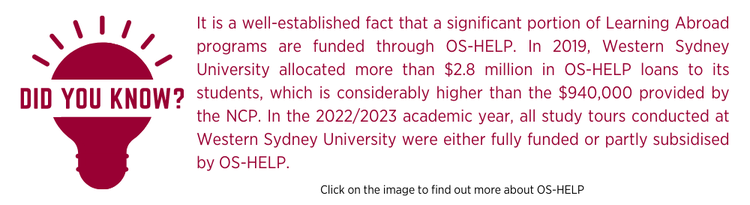
Did you know that the majority of Learning Abroad experiences are funded by OS-HELP? For most overseas programmes, the NCP only supplements the cost, so most students rely on OS-HELP loans (up to $9,504) to cover the remaining expenses. In 2019, Western Sydney University distributed over $2.8 million in OS-HELP loans to students, compared to $940,000 in NCP funding. In 2022/2023, 100% of study tours at Western were either fully funded or supplemented by OS-HELP.
OS-HELP is a deferred loan that students gradually repay through the tax system once they earn above the compulsory repayment threshold. This loan allows students to invest in their careers while gaining invaluable experiences. Participation in OS-HELP-funded programmes provides a competitive advantage compared to those who do not participate in overseas experiences. Research shows that students who recognise the value of such programmes are often willing to participate, regardless of the cost.
Advantages of OS-HELP
- The NCP only supplements overseas programmes, so most students apply for OS-HELP loans of up to $9,504 to cover travel costs, viewing this as an investment in their career and personal growth.
- The NCP is limited to programmes lasting more than four weeks and is confined to locations in the Indo-Pacific. In contrast, OS-HELP is available for locations worldwide, as long as students receive academic credit.
Western Sydney International already supports staff in implementing projects outside the Indo-Pacific that are not funded by the NCP. If you are considering running a program shorter than four weeks, please consider OS-HELP as a highly viable alternative. For more information, visit the Guidelines for Developing Learning Abroad Programs.
Note:
You must have permission from your Supervisor and School before proceeding to develop an overseas programme. All Schools/Institutes will be notified of any overseas program development, and they reserve the right to deny the submission of any NCP application.
Use of Third-Party Providers
Universities may choose to outsource all or part of project implementation to third-party providers. If this approach is taken, the relationship must be detailed in the Project Description. However, the Australian university remains fully responsible for the project, including compliance with the policies outlined in the Guidelines.
When a third-party provider is involved in implementing any part of the project, the Australian university must clearly explain how quality will be assured and how lasting relationships between the university and overseas partners will be established.
It is important to note that third-party providers are not considered NCP partners, as they receive payment for their involvement, nor can they serve as host organisations. If a third-party provider is utilised, a host institution in the host location must still be identified. The ISEO platform now allows for the recording of third-party providers separately from project partners in funding applications.
Find out more about International Partner Providers.
Existing Projects
Applications for additional funding for projects funded in previous rounds will be assessed on their merits alongside applications for new projects. Projects that have previously received NCP funding to send students offshore should be well-positioned to demonstrate the connections they have developed and maintained as a result of past NCP funding.
If a university has received past funding but overestimated the number of students who would participate in those projects, DFAT may consider this when awarding new funding.
Affordable 4-Week Programs in the Indo-Pacific
Explore a range of affordable 4-week programs offered by our partners and providers by visiting the following webpage. This page is regularly updated with new options. For instance, Universitas Airlangga in Surabaya offers several programs that include accommodation, local transportation within the city or for cultural trips, meals, and a program kit, all for a total cost of AUD 2,700 per student. If this option doesn’t meet your needs, they are happy to discuss alternative arrangements with you. Visit the webpage for more details.
Contacts
Steven McDonald
- Manager, Learning Abroad (Short Programs)
- Email: s.mcdonald@westernsydney.edu.au
- Web: Information for Staff
Cammy Chan
- Administrative Officer, Learning Abroad Government Programs
- International Liaison Officer, New Colombo Plan
- Email: cammy.chan@westernsydney.edu.au