Yesteryear
Reviewed by Jane Scerri, Western Sydney University
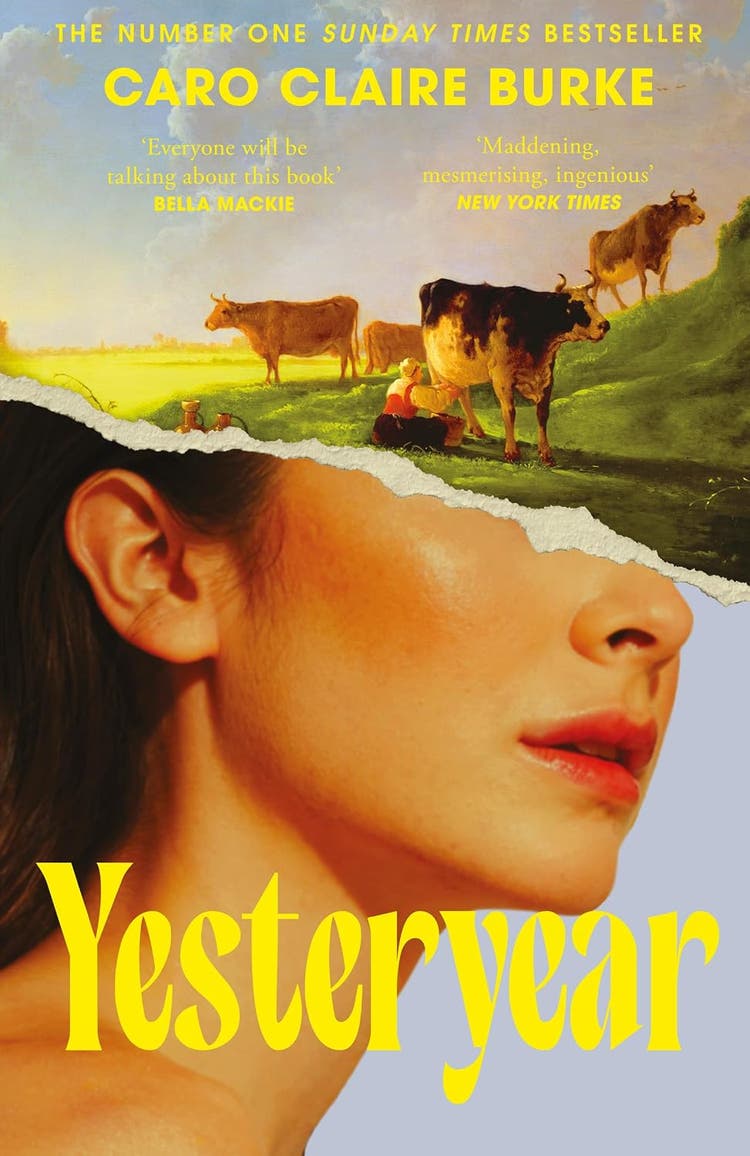
Caro Claire Burke’s Yesteryear (2026) is a satire of tradwives and the Christian right in America. Burke’s main character, Natalie is a brittle, ambitious, insecure, influencer who trades on being a stay-at-home domestic goddess/breeder and whose only real use for her children is to sell their images.
While Burke is comfortable mining this terrain of influencers and how they tick, Yesteryear’s yummy-mummy Natalie swans about the kitchen making bread and playing with her organic produce, all the while, manically checking her phone for hits. What she seems confused critiquing is the manosphere and American politics, most especially, race and female agency.
For all that she aspires to and all that she achieves, Natalie barely leaves the house, except to go outdoors to talk to her ‘ladies’ (the chooks). She settles for a dolt of a partner and no sex life, despite the six children. When she does venture out – typically taking the kids to Target – she runs into her nemeses, other women – most especially, the ‘Angry women’.
These are the women who pursue careers and lives in the world outside the home, some of whom hold feminist notions and some of whom write mean comments on her posts, such as: ‘Wait, is she a Nazi, lol’ (297).
All women are her enemy in the novel – her mother, her sister, her daughters, her ex-college friend Reena, her producer, Shannon. And yes, this is the world Burke is making of fun of – the one in which Natalie in her pursuit of Insta-fame and wealth sells herself and her children short – but for this reader – her message is confused.
I found the novel unstable and unconvincing, and while it is not essential to like the characters in a novel, I found them largely inconsistent and unrelatable – save for the upstairs-downstairs-style depictions of the ranch staff in the present-day era and the main character, Natalie’s father-in-law, Doug. Doug is a rusted-on Republican running for presidential office, and the only match for the scheming Natalie who not only pitches herself as a homespun, domestic goddess, but also as a Christian who thinks women should be homemakers and breeders, and men should be ... well, just rich and breeders. She muses:
Her Lord is sought as a provider: Thankyou father for Caleb ... for the inheritance ...and for helping us pass five million on Instagram this week (5).
Early in the narrative, Doug drops a lazy five million into Caleb’s account so they can buy Yesteryear ranch and, in the process, give Caleb an identity.
Natalie’s Christian convictions are what I first find jarring in the novel – not that Christians can’t be scheming and self-centred – there is just nothing believable about her religiosity. A Christian reviewer states:
Yesteryear aims to immerse readers in the psychology of traditional Christian women, and it left me wondering whether Burke has ever spoken to one (Graham, 2026).
Burke’s modernity, point of view, and agency permeate the writing and for me this is what confuses the message throughout. As stated, she is convincing in locating specific elements of the manosphere and tradwives, and has some good digs at influencers, preppers and anti-vaxxers, for example (after ‘the twist’), when she calls Caleb ‘a doomsday prepper loon of a conspiracy theorist’ (373).
Even more jarring is how Burke deals with race. In the present of the novel, as soon as the likes and comments for Yesteryear farm start rolling in, Natalie hires nannies and a producer (21-year-old Shannon). Shannon commits her first faux pas when she unwittingly films one of the Mexican workers ‘those dumb fucking immigrants’ (215) who forgot to hide the Deet (pest control).
The novel continues insensitively, about race-relations in America – there are multiple othering references to ‘Indians’ (pps.31, 59, 53, 208, 243, 388). Surely a writer critiquing the right-wing influencer/manosphere and all its narcissistic psychobabble in 2026, should be aware that pitching the ‘Indian’ as the bogeyman is, in and of itself, an unfortunate relic of yesteryear. Natalie warns Mary, the surly, older daughter from the olden days section of the book, not to go out into the woods because:
There are all manner of terrible things in there. Wolves and Indians and other souls who are bent (153).
Similarly, it is only white Americans that are discussed sympathetically:
The white race was going extinct (44).
Later, when she and Caleb are discussing the outside world and what it teaches children they muse:
They teach little white children to feel guilty about the fact that our country used to have slaves (155).
For me, despite that Burke positions this work as satire, there are too many racial comments like this that need contextualising if they are to be read as funny.
Which brings me to another confusing element in the novel. In Yesteryear: Natalie pitches herself as a religious, down-home, bread-baking, Christian, tradwife influencer, yet to my mind she is no different (sexual politics wise) to your garden-home variety ‘gold digger’ of any era. She hitches herself to lazy, dropkick, Caleb whom she can only view as attractive, when caricatured in cowboy gear. In an interview for The Atlantic (Rosin, 2026), she claims she made him purposefully nice – as a counterfoil – but he is bland. The only man Natalie finds attractive is the ultimate patriarch, her father-in-law, Doug – is the message here that she can only find pleasure when in the hands of an alpha male? Is Caleb the closest she can get to the Oedipal father, Doug?
Admittedly, Natalie needs Caleb for the cash (and the sperm) and Doug has made it clear her name is not on the title for the farm, to which she, trills, ‘I was going to suggest that anyway’ (203). Natalie must mollify Caleb, whose ‘penis flop[s] away like a slinky’ (185) and repeatedly cannot get it up (except later for Shannon) and inseminates herself with a turkey baster once he’s partaken of a little porn. At one point, I wondered if the twist would be that Caleb was more your Brokeback-Mountain-style cowboy than the down-home son of a presidential gun from Idaho. The only time Natalie finds a man attractive is when he is dominating her: Caleb in the guise of the austere pioneer in the tedious 1855 sections of the book – ‘I don’t like hitting you,’ (205), and Doug, as the misogynist presidential candidate, who, at least in sparring/scheming terms is her equal. This friction/frisson between Doug and Natalie is, arguably, the most interesting part of the story.
The plot is shaky, feels wedded to a clunky premise and the narrative is disturbingly jerky – I found myself skipping the 1855 sections as nothing really happened in them – except that the eldest child, Mary hates Natalie and that Natalie finds the stern Christian wife-beater version of Caleb more sexually attractive than his modern incarnation. Her sexual politics are inconsistent. Sure, she marries Caleb for his cash – that’s not the problem, nor is it anything new – what is the problem is that she doesn’t fancy him, thinks he is stupid – no, arguments there! – yet does not properly locate him in the manosphere.
He rarely leaves his conspiracy-theory chat rooms, except to do a spot of home schooling with the kids about the perils of the outside world. Has she in fact, unwittingly married an InCel (Involuntary Celibate)? I found myself skimming the olden-day scenes, which, thankfully, do get shorter as the novel progresses. The children in this part are a different batch, and more adept at running the farm than Natalie is, and for ages it is explained that Natalie thinks she is on an Insta-set from which she will be rescued (this too is confusing because she controls all the filming so she’d know no one was coming!).
Suffice to say it is ‘resolved’ in the much-awaited twist, but this sub-plot goes for too long and having to get to know two lots of children is tiresome.
Again, the caveat, that Burke is clearly satirising, but as with the comments about race, many of the gendered comments are tedious. On the joys of having three girls Natalie coos:
A girl was lovely, a boy was nice, but girls, plural, were rainbows and fluff ... Radiant balls of delight ...They picked and preened and poked at one another with motherly obsession (11).
There are, however, some funny moments in the novel. Ever scathing of other women, when Natalie appraises her older sister who is ‘only thirty but could pass for forty-five’ she comments:
Her arms, her breasts, her jowls. Not fat- not yet at least – just deflated. That’s what children and poverty do to you – suck the collagen right out of you (201).
It seems fair enough that Burke has chosen to lampoon tradwife influencers and the fact that what they are selling – domestic bliss is markedly skewed from modern women’s reality. But this is not a new thing – there are always all manner of snake oils and fantasies for sale. ‘Virtuality’ is an apt word that pops up in the novel – and what Burke is trying to do is interesting – but this blurring of imagined life and real life is not new for women. Think Covid and the emergence of the work/home life balance – there were so many discussions about its pros and cons and in a sense in Yesteryear, this is exactly what Natalie, courtesy of her dropkick husband and cashed-up father-in-law is doing. She is running a home business in the era of influencers in a country that has been ruined by Trump and his angry men. Yet the only angry people she decries are the Angry Women! This is my main gripe with this novel – if ‘the Indians’ ‘the Mexicans’, ‘the slaves’, and any working women who dare to criticise domestic glorification and female oppression are the enemy, then who is she batting for?
About the book
Author: Caro Claire Burke
Publisher: Alfred A. Knopf
Date: 2026
ISBN: 979-8-2172-8-7857
References
Graham, L. (2026, May). I’m a Tradwife influencer: Here are my thoughts onYesteryear. The Heritage Foundation.
Rosin, H. (2026, May). The tragedy of the TradWife. The Atlantic.
About the reviewer
Dr Jane Scerri holds a Master’s and a DCA in creative writing, both of which discuss the works of late 20th century Australian women writers. She has published short stories, poetry, book reviews, journal articles and literary criticism in TEXT, Global Media Journal, ASAL and Swamp writing, and currently teaches philosophy, literature and Indigenous studies at Western Sydney University.
Read more
This book is from Volume 18.