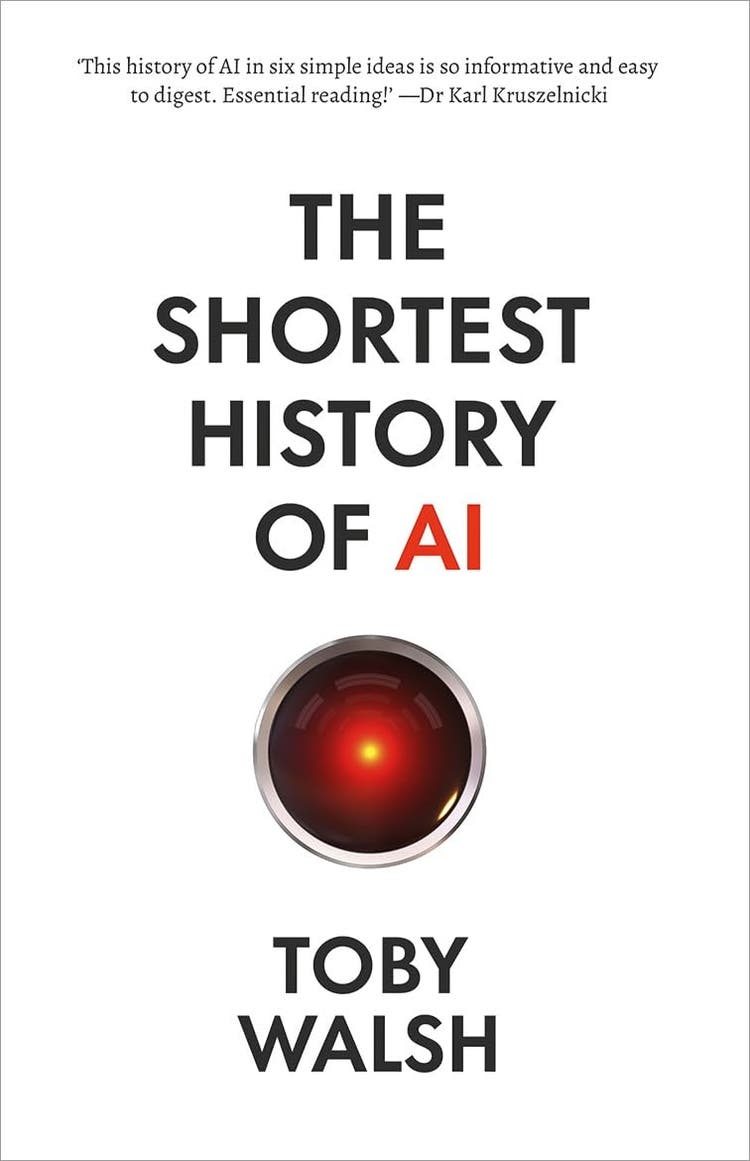
The Shortest History of AI
Reviewed by Hart Cohen, Western Sydney University
Toby Walsh is a British computer scientist who is chief scientist at UNSW.ai, the AI Institute of UNSW Sydney. He is a Laureate fellow, and professor of artificial intelligence in the UNSW School of Computer Science and Engineering at the University of New South Wales and Data61.
As a reminder of the bestseller that was read by few, Stephen Hawking’s (1988) A Brief History of Time, Walsh’s book with its similar title, may suffer a similar fate. Not so much because of the content, which is accessible and largely jargon free, but because the field of AI moves on at quite a clip and even offering a ‘short history’ so that it could be read prior to the ‘next big thing’ in AI, the history may still be overtaken before you’ve completed the book. It may be a close-run thing.
That said, quite a good graphic is presented at the outset of the book that divides the history of AI into five (5) periods:
- Prehistory (1837–1955)
- Symbolic Era (1956–2011)
- Learning Era (2012–2017)
- Generative AI ERA (2022–2024)
- The Future.
The fifth period is titled ‘the Future and captioned: ‘The 2018 book by the author <Toby Walsh> titled 2062: The World that AI Made’, which predicts that machines will have matched human intelligence by 2062 is finally proven wrong.
This is a kind of cheeky way of embedding some degree of scepticism about the inevitability of machine dominance in the future and the catastrophising about AI that is a regular feature of contemporary commentary on AI from journalism to gossip with a good amount of these pronouncements emanating from LLMs themselves.
The graphic is in fact a table of contents tracking the prehistory and then proto developments of AI into the current LLM phase of ChatGPT and related platforms for both intelligence and images. The preface sets up the book in two ways: there is a ‘dramatis personae’ providing the key players in the story of AI. Second there is an emphatic point made that AI is force with Manichean tendencies – that is, there is from the get-go the sense that risks and benefits of AI will be in constant negotiation and with no assurance that the benefits will win out.
‘Part 1, The Symbolic Era’ chapter sets up the early stage of AI where the focus on language presages the now large language models that are germane to AI. Each chapter has sections based on ‘Ideas’ and so in this chapter the first idea is focussed on ‘Answering Questions’. The essential moment celebrated at this stage is the move to ‘search’ – or to making the then AI focussed on finding ‘answers’ again previewing the ‘prompt’ in the contemporary CHATGPT platform. But at this stage these are early stabs at means-end analysis and problem-led solutions. The next idea in this chapter is titled, ‘Making the Best Move’ and reminds us how central games were to bringing AI into public view. The celebrated chess games between Kasparov and IBM’s Deep Blue, along with checkers, poker and backgammon showed how machines could exceed the human capacity for anticipating moves in a game. Idea #3 titled, ‘Following Rules’ suggests that AI is adapting logics from human thought and becomes embedded in systems many of which lie ‘behind the backs’ of human activities.
An ‘intermission’ chapter offers a short history of robots and ‘roboticisation’. The co-development of robots and AI are symbiotically linked as well as the confluence of computing, sensor and imaging technologies.
Part 2, ‘The Learning Era’ includes the Generative AI era and is the most significant in that it spans the period in which computers are programmed ‘to learn’. The culmination is with the large language models and image generators among others. With idea #4 ‘The Artificial Brain’, this is also the period when companion bots and deep neural networks open up new opportunities for human-machine interactions.
The key moments develop in a stop-start fashion – where the rejection of a strategy for replicating neural networks is re-calibrated to form the basis for the AI that has become now familiar to us across many applications. It is not only the innovations in deep neural networks but also the emergence of larger ‘training’ data sets facilitated by the Internet and furthered by the augmentation in computing power. This section also covers the relatively recent emergence of companies who were able to push the models aggressively (e.g., Open AI) and bring us to this moment where AI appears to regularly provoke either a great breakthrough or dangerous innovation. There is special attention given to Chat GPT and it is worth quoting Walsh directly given the importance afforded to this AI innovation:
GPT stands for Generative Pre-trained Transformer…’Generative’ means that the model can generate text. ‘Pre-trained’ means that the model is pre-trained with no particular goal in mind other than to discover features in the training data. In this case, the model develops a general understanding of language and then is trained for specific tasks such as answering questions, translating text or finishing sentences. And ‘Transformer’ is because the model has a transformer architecture.
In November 2022. OpenAI made a master move and built a chatbot called ChatGPT on top of the GPT family. ChatGPT, which stands for ‘Chatting with GPT’ (123-124)
Walsh also notes that OpenAI chose the acronym, GPT as it also stands for General Purpose Technology, a term that implies sweeping applications that impact whole economies. They compare it to watershed innovations (e.g., the steam engine or electricity) that are transformative across generations and cultures. The implication is that AI is heading towards Artificial General Intelligence (AGI) which is when human intelligence is matched by machine intelligence. Walsh thinks that this is not going to happen soon.
With AI moving at a rapid pace, this book may be a timely reminder of how the history of new technologies contributes a sense of perspective. If we apply the adage, ‘when old technologies were new’ to understanding AI, it may enable us to better understand the future of both the benefits and threats posed by this new technology.
About the book
Author: Toby Walsh
Publisher: Black Inc.
Date: 2025 (pp. 256)
ISBN: 978-1-7606-4-5137
About the reviewer
Professor Hart Cohen (he/him) is Emeritus Professor in Media Arts in the School of Arts and a member of the Institute for Culture and Society at Western Sydney University, Australia.
Dr Cohen has published widely in the field of visual anthropology, communications, film and media studies and directed three Australian Research Council Projects related to the Strehlow Collection held at the Strehlow Research Centre in Alice Springs. Dr Cohen directed three films in relation to these projects: ‘Mr. Strehlow’s Films’ (SBSi 2001) and ‘Cantata Journey’ (ABC TV 2006) ‘Ntaria Heroes’ (2016).
Dr Cohen is co-author of the award-winning book, Screen Media Arts: An Introduction to Concepts and Practices (Oxford University Press 2009) and editor of the Global Media Journal /Australian Edition (2007–present.
His most recent sole-authored book is, The Strehlow Archive: Explorations in Old and New Media (Routledge 2018) and his most recent edited book is Digital Humanities in the India Rim (OBP, 2024).
Read more
This book is from Volume 18.