The development and semantic change of noun-noun compounds in Mandarin Chinese: A corpus-based analysis
Jane Chanell, Western Sydney University
Abstract
This study examines the development and semantic change of noun-noun compounds in Mandarin Chinese, addressing a historically underexplored aspect of diachronic semantics and morphology. Traditionally, these compounds were thought to originate in Medieval Chinese (220–960 CE) due to phonological simplification. However, recent findings suggest their presence in Archaic Chinese (1676–209 BCE), prompting a renewed examination of their development. Analysing 392 complex words from historical dictionaries and linguistic corpora, the study identifies three structural types in early Archaic Chinese: compounding, derivation, and univerbation.
Additionally, it reveals three primary types of semantic change: conventional, metaphoric, and lexicalised. Quantitative analysis indicates that lexicalisation is the dominant process through which compounds acquire new meanings, with metaphorical extension playing a secondary role. Notably, coordinative compounds are more susceptible to lexicalisation than subordinative ones.
The findings are contextualised within key features of the Chinese language, including its simplified syllable structure, high homonymy, and logographic script, all of which shape the trajectory of semantic change. This research offers new insights into the development of Mandarin compound words, contributing to a broader understanding of historical semantics, morphological processes, and lexical change in Chinese.
Introduction
Language is in a constant state of evolution, with the development and semantic change representing one of its most prominent and observable dimensions. Such changes are shaped by both internal linguistic mechanisms and external social dynamics (Bybee, 2015; Campbell, 2013). The development of disyllabic words in Mandarin Chinese exemplifies this complexity, particularly in terms of their origins and patterns of evolution.
Within the literature, the consensus among scholars is that disyllabic words were largely absent in early Archaic Chinese1 (AC, prior to 220 BCE), emerging predominantly in Medieval Chinese (MedC, 220 CE–1368 CE) due to phonological simplification (Karlgren, 1926; Li, 1993; Pulleyblank, 2000; Wang, 1958). However, recent corpus-based research by Chanell (2019) has challenged this view, providing evidence that noun-noun compounds existed as early as the Archaic period (1676 BCE–209 BCE). Despite their early presence, the use of compound words has proliferated dramatically since then, now accounting for over 70 per cent of the contemporary Mandarin lexicon (Chao, 1968; Duanmu, 2007; Li, 1993; Li & Thompson, 1981; Packard, 2000; Pulleyblank, 2000; Wang, 1958; Wu, 2001). This finding contradicts earlier assumptions that the Chinese language originally featured minimal compounding morphology (Feng, 1998; Karlgren, 1926; Pulleyblank, 2000).
The study of the development and semantic changes in noun-noun words in Mandarin Chinese holds profound interest for historical linguists. This is largely due to the language’s extensive historical evolution and its distinctive orthographical system. Unlike alphabetic scripts, Chinese characters uniquely represent morphemes and preserve semantic continuity over time. This feature makes them particularly valuable for identifying historical structural types of complex words and for studying historical semantic shifts, such as metaphorical extension and lexicalisation, which often result in opaque or polysemous meanings.
While the presence of noun-noun compounds in AC is now acknowledged, the mechanisms underpinning the rise and their diachronic semantic trajectories have not been systematically analysed. This study addresses that gap by undertaking a corpus-based analysis of noun-noun constructions in early Chinese texts. The research focuses on identifying the types of word formation processes and the patterns of semantic change in these constructions. Data for this examination is drawn from several sources: Hanyu Da Cidian (Lou, 1993), The ABC Etymological Dictionary of Old Chinese (Schuessler, 2006), the Center for Chinese Linguistics Corpus (CCL, Peking University, 2014), and the Sheffield Corpus of Chinese (SCC, University of Sheffield, 2007).
The remainder of this paper is organised as follows: The literature review offers a comprehensive overview of Chinese compounds, with a focus on disyllabification and the semantic models of noun-noun constructions. The framework section explores various models and mechanisms related to semantic change within compounding. In the methodology section, we outline the data sources, research design, and methodological approach used in this study. Following this, the results and discussion section presents the analysis and findings. Finally, the paper concludes with a summary and a discussion of the broader implications of the research.
Literature review
Previous accounts of the use of disyllabic words in Mandarin Chinese
Previous research has attempted to correlate the rise of disyllabic words in Chinese to phonological and social shifts (Cheng, 1982; Feng, 1998; Karlgren, 1926; Li, 1993; Pulleyblank, 2000; Wang, 1957). For instance, Karlgren (1926), Wang (1958), and Li (1993) argued that phonological simplification during the Han Dynasty (206 BCE–220 CE) led to an increase in homophones, prompting the development of compound words to maintain lexical distinction.
Indeed, the transition from AC to MedC saw notable changes in syllable structure, including the reduction of consonant clusters and the loss of final consonants, as depicted in (B) and (C) in Table 1 (Baxter, 2010; Haudricourt 1954 & 1972; Karlgren, 1926; Pulleyblank, 2000; Sagart, 1999; Schuessler, 2006 & 2009). As shown in Table 1, this reduction caused morphemes that were phonologically and morphologically distinct in AC (as shown in Table 1C) to merge into single, phonologically indistinct syllables jam (as shown in Table 1B) in MedC, though their original meanings were retained.
Table 1: Examples of simplified sounds in the history of Mandarin Chinese (Schuessler, 2006; 2009)
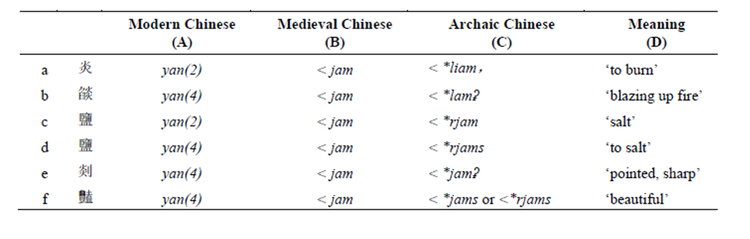
Given the semantically different words sharing a common structure in MedC as indicated in Table 1, it is logical to assume that compounding developed to reduce homophony. However, a closer look at Table 1 reveals something unexpected by the theories of Karlgren (1926), Wang (1957), and Li (1993): homophones already existed in AC. It makes clear that, in AC, the syllable structure *rjams in (d) and (f) in Table 1 was phonologically the same, yet they represented two different morphemes or characters. More evidence of the same was also formally identified in Schuessler (2006).
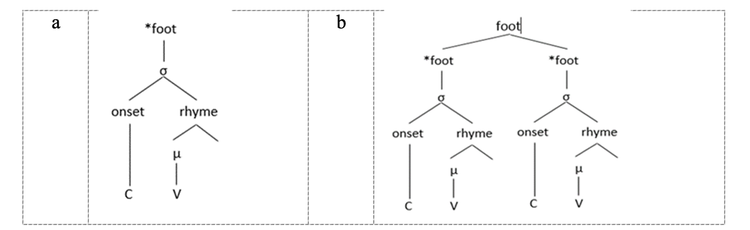
Feng (1998) argued that disyllabification in Chinese was not directly caused by homophones, but by a shift from complex to simpler syllable structures. In AC, complex syllables (like CVC) could form a two-mora2 prosodic foot (Figure 1), with consonants contributing moras, satisfying prosodic word principles (McCarthy & Prince, 1993). However, MedC simpler CV syllables, lacking final consonants, could only form one mora. To meet the prosodic word principle, these simple syllables needed at least two syllables to form a two-mora foot (Figure 2).
Figure 1 & 2: Prosodic structures in AC & MedC (Feng 1998) (µ=mora, σ=syllable node, C=consonant, V=vowel)
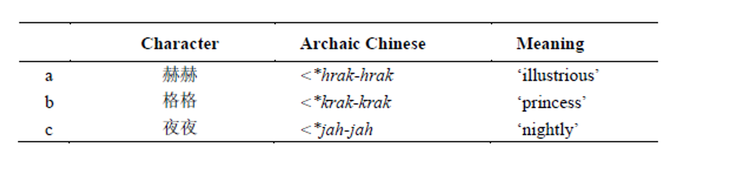
Despite this explanation, the prosodic account has limitations. Disyllabic words existed even within the complex syllable system (Table 2), and many monosyllabic CV-structured words—such as shū 书 ‘book’, zhǐ 纸 ‘paper’, and bǐ 笔 ‘pen’, remain common in Modern Chinese, comprising around 20 per cent of the vocabulary (Chao, 1968; Duanmu, 2007; Li, 1993; etc.). This suggests that prosody alone cannot fully explain disyllabification.
Both the prosodic and homophonic hypotheses ascribe the rise of disyllabic words to phonological simplification. However, this explanation might be incomplete, as homophones existed before syllable reduction, and complex syllable structures facilitated two-syllable words (Labov, 1987; Wu, 2001; Zhang, 1992). Recent research further challenges these views, showing that disyllabic words were used before phonological simplification (Chanell, 2019). This suggests that various factors, not just one, drove the emergence of disyllabic words in early archaic periods. There is a significant lack of research on Chinese complex word development from a morphological perspective, largely due to misconceptions about Chinese morphology. This gap highlights the urgent need for further exploration in this area.
Previous approaches to semantic relations of noun-noun compounds
Noun-noun compounds are prevalent across many languages, including English and Mandarin. Compounding stands out as one of the most productive processes of word formation (Downing, 1977; Jespersen et al., 2006, p. 139; Li & Thompson, 1981; Packard, 2000; Ryder, 1994), enabling speakers and listeners to create new terms in real-time to meet immediate communication needs. For instance, the compound ‘cake girl’ might be formed to describe a girl who has eaten an excessive amount of cake at a gathering. According to Marchand’s (1969) derivational approach, the possible grammatical relationship between the cake and the girl can be perceived as the cake being an object of the potential verb. While compounds can be spontaneously generated, they typically follow established rules to structurally and semantically connect their constituent elements (Scalise, 1986, p. 9). Further, Marchand (1969) categorised nominal compounds into verbal nexus (e.g., prize winner, consumer protection) and non-verbal nexus (e.g., oil well, arrowhead) based on their underlying grammatical structure. Verbal nexus compounds overtly display sentential relationships, often resulting from nominalising a predicate, e.g., ‘carmaker’ from ‘making cars’ (Selkirk, 1982). Non-verbal nexus compounds, as in ‘steamboat’, however, involve predicate deletion (Levi, 1978; Marchand, 1969).
The idea that compounds originate from underlying sentences presents challenges due to the variability of these deep structures. A single compound, such as snake poison in (1), may correspond to multiple possible sentential interpretations, highlighting the difficulty in determining the exact meaning of a compound solely from its syntactic origin (Downing, 1977; Levi, 1978; Scalise, 1986).
- Someone extracts poison from the snake
- The snake has the poison
- The poison is for the snake
This suggests that while noun-noun compounds express a relationship between two elements (either entities or concepts), they do not inherently specify how that relationship should be understood. Newly formed or unconventional compounds, such as ‘cake girl’, do not fall back on a single immediate context, leading to potential variations in the contexts within which a compound may be employed. For example, ‘cake girl’ could mean a girl whose occupation is baking cakes or one who lives next to a cake shop. Despite this potential ambiguity, the semantic connection between the two compound members persists, allowing for interpretation from their component parts, even if context is lacking.
Despite such challenges, the meaning of most compounds can still be interpreted based on the semantics of their components, even when partial compositionality is involved, as in ‘blackbird’, which refers to a type of bird regardless of its actual colour. While Marchand’s (1969) derivational model does not account for all cases, it aligns with Frege’s (1893) principle of compositionality—the idea that the expression meanings, such as phrases and sentences, is derived from the meanings of individual parts. This principle applies not only to sentences but also to words and compounds like ‘policeman’ or ‘water tank’ (Kiefer, 2002; Mailhammer & Smirnova, 2013).
The context in which a compound appears plays a significant role in guiding one toward an accurate understanding of its meaning. However, the contextual requirement does not necessarily limit the relationship between the constituent nouns in a compound (Downing, 1977, p. 811; Ryder, 1994, p. 9). The compound ‘cake girl’, for instance, could come to mean a person who eats excessively cake with no consideration of others, subsequently implying a selfish individual. In such cases, the meaning of a compound becomes entirely unpredictable from its constituents, as the relationship between the two nouns can take on any meaning that might exist between their referents in different situational contexts (Downing, 1977, p. 811; Levi, 1978, p. 68; Ryder, 1994, p. 9; Scalise, 1986, p. 8). As Taylor (2002, p. 100) stated, such exceptions—such as idioms, metaphors, and context-dependent expressions—demonstrate that strict compositionality is often the exception rather than the rule.
Theoretically, the context requirement of compound words allows for multiple interpretations of the same compound, meaning their meanings can be opaque and may undergo semantic change over time. In practice, though, many established or existing compounds can be frequently used and understood without a specific context. For example, a ‘goldfish’ is conventionally understood as a fish resembling gold, but the term ‘goldsmith’ does not refer to a smith with a gold-like appearance. This discrepancy arises because these “compounds have become traditional names for one definite thing after the compounds were created” (Jespersen et al., 2006, p. 137). Such compounds were formed for enduring usage, making alternative connotations redundant (Jespersen et al., 2006, p. 137), and they often become permanently listed in the lexicon (Packard, 2000, p. 115). For instance, the terms ‘goldfish’ and ‘goldsmith’ are syntactically parallel compounds, but they do not exhibit semantically parallel. Both are endocentric and determinative compounds, but their precise semantic relationship differs. Once they are established as lexical items, the potential to modify the relationship between the constituents of these compounds diminishes, irrespective of the lack of ultimate justification (Jespersen et al., 2006, p. 137). In general, compounds frequently used without a contextual requirement can exhibit either predictable semantic patterns, as observed in ‘goldfish’ and ‘goldsmith’, or unpredictable ones, as evidenced by ‘paleface’ and ‘blockhead’.
The primary challenge in understanding the semantic relations of nominal compounds stems from predictable compounds rather than unpredictable ones. Predictable compounds have a significant influence on determining the expression of constituent elements. The inherent arbitrariness of the relation between these constituent elements, alongside the reference to the head, further complicates this challenge. Consequently, the semantic interpretation of nominal compounds is a significant area of contention among scholars. Previous studies on noun-noun compounds have attempted to categorise patterns based on the semantic nature of the members in the compounds or on their grammatical and semantic relations between the members of the compounds in synchronic senses (Adams, 2016; Chao, 1968; Downing, 1977; Hatcher, 1960; Jespersen et al., 2006; Lees, 1966; Levi, 1975; Li & Thompson, 1981; Marchand, 1969; Scalise, 1986; Warren, 1978). However, the fundamental mechanisms and determinants of this linguistic development remain largely unexplored. Since the initial goal of this study is to gain an understanding of the construction of compound noun-noun expressions in Mandarin Chinese, it is important to comprehend the relationships between compounds and their component parts in terms of compositionality. This involves understanding how a given compound can be derivable and predictable from the semantics of its composite parts. The compositional hypothesis, serving as a practical and invaluable diagnostic tool, would be essential for the comprehensive analysis of constructions involving noun-noun compounds.
In summary, current research provides limited insights into the morphological development and semantic changes of Chinese noun-noun compounds, especially concerning their word formation processes and patterns of semantic change. Introducing a new linguistic theory has the potential to open new avenues of understanding, resolving challenges from existing approaches, and significantly enhancing our comprehension of noun-noun compounds in Chinese and potentially in other languages. This study seeks to address these gaps by analysing specific noun-noun combinations, focusing on the following key issues:
- What types of disyllabic noun-noun words existed during the early period of AC, and through what word formation processes were these original disyllabic words formed?
- Do the semantic changes in individual compounding words align with established models or do they introduce new patterns by accumulating additional meanings over time?
These research questions will be addressed through a comprehensive historical analysis of noun-noun constructions from early AC to Contemporary Chinese, grounded in established theoretical frameworks, including both synchronic and diachronic morphological analysis theories, which will be presented in the next section.
Research Framework
This paper aims to achieve two primary goals, as outlined in the literature review section. First, it seeks to identify the types of disyllabic noun-noun words present in early AC and analyse their formation processes. Second, it investigates whether semantic changes in individual words align with established models or introduce new patterns through the accumulation of additional meanings over time.
To accomplish the first goal, it is crucial to apply specific criteria for classifying noun-noun words as compounds, derivational words, or univerbated3 words. The key distinction between compounds and derivational words lies in differentiating bound roots from word-forming affixes.
For a noun-noun complex word to be classified as a derivational word, one of the constituent elements must function as an affix (either a prefix or a suffix). This affix must satisfy the following criteria.
- It carries a grammatical meaning across contexts that are relatively variable and unpredictable,
- It is applied selectively to only certain members of a category,
- It consistently occupies a fixed position in relation to the root (or stem) to which it is attached, either as a prefix or a suffix.
- It has the potential to change the form class (part-of-speech) of the item to which it is attached, and
- It is attached to either free or bound roots to create a new word.
In analysis of noun-noun combinations, these criteria do not need to be followed in a specific sequence. However, criteria (1)-(3) should be met concurrently to determine whether a bound morpheme functions as a bound root or an affix. This simultaneous consideration is vital for thoroughly evaluating shared features with bound roots and for distinguishing them from affixes.
The second goal of this paper is to provide a developmental pattern of semantic change in language history, especially in compound words. This pattern will be achieved via shaping by the early frameworks from scholars such as Campbell (2000; 2013), Bybee (2015), Gillon and Mailhammer (2015), Joseph (2020), Lehmann 2020, Mailhammer (2013), Packard (2000), Trips (2017), Urban 2015 and others.
I will begin by providing a concise overview of the fundamental principles that influence meaning changes in noun-noun compounds, drawing upon the theories explained in the aforementioned works. Table 3, based on earlier models, outlines those particularly relevant to semantic changes within compounds.
Table 3: Earlier models and mechanisms in semantic change
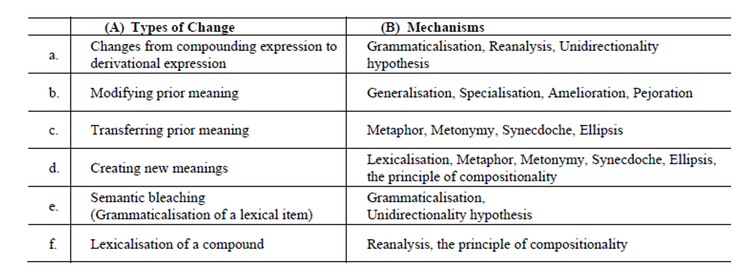
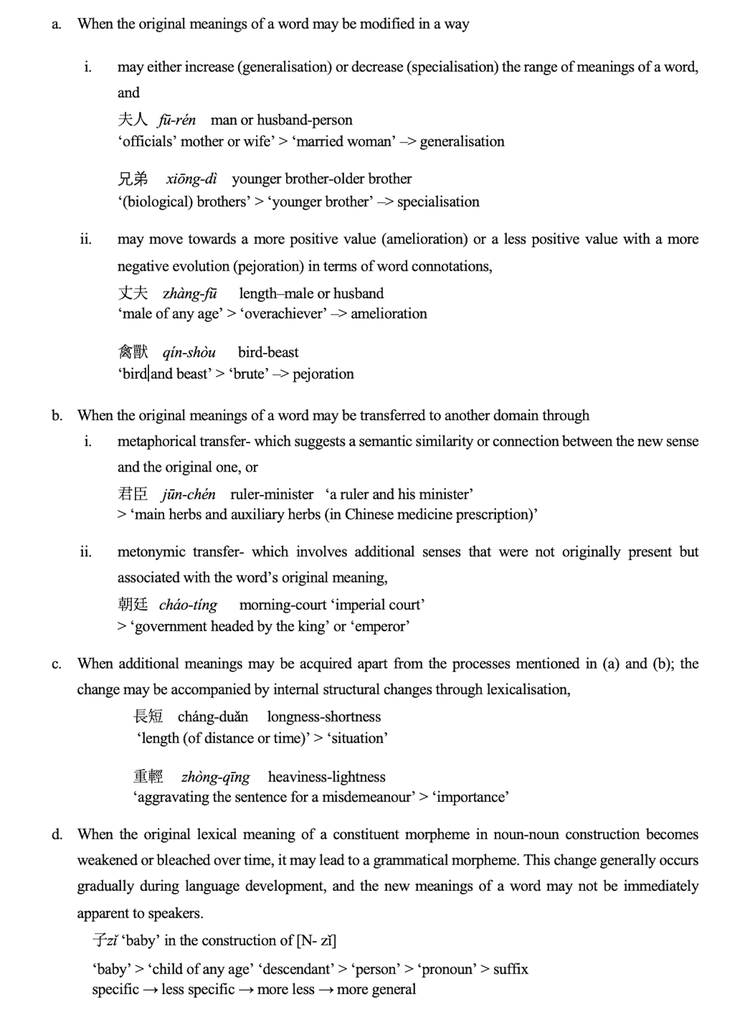
The changes outlined in Table 3, including the types of change and the mechanisms of change, bear substantial relevance within the domain of compounding morphology. These changes are anticipated to manifest in noun-noun constructions in the Chinese language, serving as the primary focus of the inquiry into semantic change. The classification from (a) to (f) demarcates the extent of a theory of change in compounding morphology.
Notably, there exists a discernible overlap in the mechanisms driving distinct categories of linguistic change, as demonstrated in column (B), suggesting that certain operational mechanisms in one type of linguistic change also manifest in others. It is important to underscore that these changes pertain to individual complex constructions rather than the reconstruction of compounding morphology systems.
It is noted that the repetition of the same approach or mechanism in column (B) is a notable feature, stemming from the fact that a change in column (A) may encompass multiple approaches. For example, 禽獸 qín-shòu bird-beast, originally meaning ‘bird and beast’, underwent a semantic change to have the meaning of ‘evil’. This transformation occurred through the simultaneous operation of two mechanisms: degeneration (where the negative traits associated with wild animals were applied to human behaviour) and lexicalisation (where the compound is lexicalised into a monomorphemic word with non-compositional meaning). These enumerated theoretical approaches provide valuable assistance in recognising the primary change types and explaining the evolutionary process of word structures and formation over time.
Data and Method
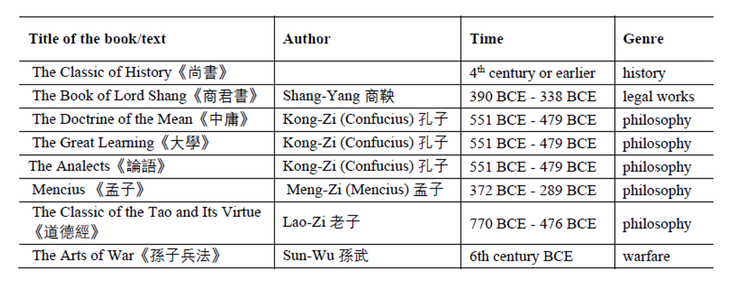
The data for this study, focusing on the distribution of noun-noun combinations in early AC, comes from a digital corpus of 392 noun-noun words. These words were extracted from eight sample texts4 within the Sheffield Corpus of Chinese (SCC), established in 2007. The selected texts are considered classic literary works from that era (pre-209 BCE) and represent four distinct genres: history, legal works, philosophy, and warfare. The 392 words were derived from 1811 noun-noun types and 4808 noun-noun tokens found in early AC (pre-209 BCE). They represent the top 1811 most frequent noun-noun types, with each sequence appearing at least three times. This systematic approach to data collection was employed to avoid potential bias.
Following the initial collection, specific types of proper nouns were excluded from the 392 extracted items. This exclusion covered personal names, geographical names, institutional names, religious and mythological names, and technical names. These categories of proper nouns are generally characterised by stable structural and semantic compounds, making them unsuitable for examining semantic change.
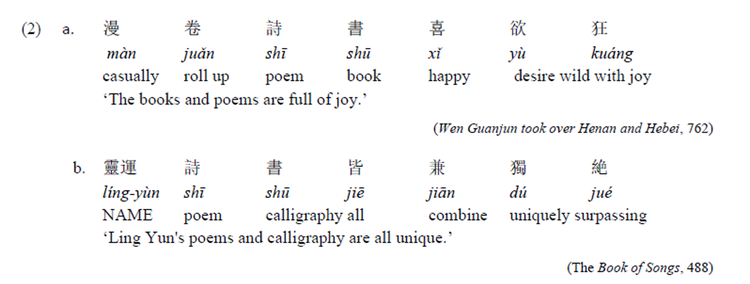
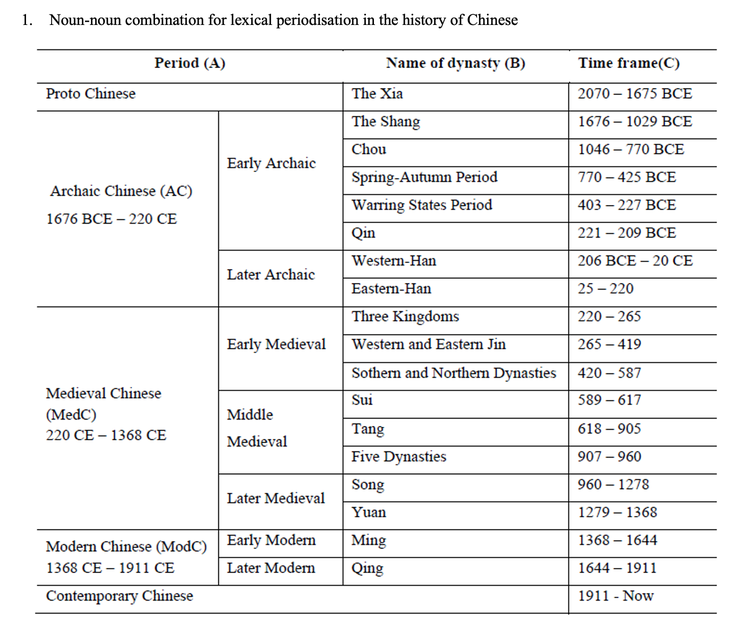
However, not all proper nouns were excluded, as the same character construction can represent both non-proper and proper nouns depending on the context. For example, the proper noun 詩書shī-shū ‘The Book of Songs and The Classic of History’ refers to both <詩经> ‘The Book of Songs’ and < 尚書> ‘The Classic of History’. The formation of this proper noun involves the simultaneous truncation of the surface of the second part of <詩经> and the surface form of the first part of <尚書> during word-formation procedures. Interestingly, in MedC, the same 詩書 shī-shū form was applied in distinct contexts with differing meanings: as a general ‘book’ (2a) and as a collective noun with the meaning of ‘poetry and calligraphy’ (2b). This exclusion process ultimately removed 75 proper nouns, reducing the dataset to 317 words for the analysis of noun-noun word distribution in early AC.
The subsequent step involved systematically categorising each disyllabic word from the previous steps into one of three classifications: (i) derived words, characterised by the attachment of derivational affixes to specific roots, such as -zi and -zhe, (ii) compound words, classified according to the syntactic relationships between their constituents, including subordinative and coordinative structures, and (iii) univerbated words, marked by the process of creating a single word from an expression or construction that originally consisted of multiple words.
The main goal of this comprehensive classification is to identify the patterns associated with the various types of disyllabic words that emerged in early AC. This analysis aims to uncover the linguistic rules governing these disyllabic constructions and highlight the most prevalent forms. Once these patterns are established, words conforming to them can be examined across different historical periods, from early AC to Contemporary Chinese. This refined dataset, comprising various types of noun-noun words, forms the foundation for the core objectives of this research: tracking the development of disyllabic words over time, uncovering the types of changes that occurred, and determining the underlying mechanisms behind these changes.
The subsequent step involved examining the semantic properties of the noun-noun words obtained previously. This examination included an analysis of semantic changes, focusing on how meanings were modified, created, and transformed. To illustrate this process, a two-part table, similar to Table 4, was employed. This table was designed based on the anticipated types of semantic changes identifiable in Mandarin noun-noun words, as explained in the framework section.
Table 4: Examination of individual N-N words
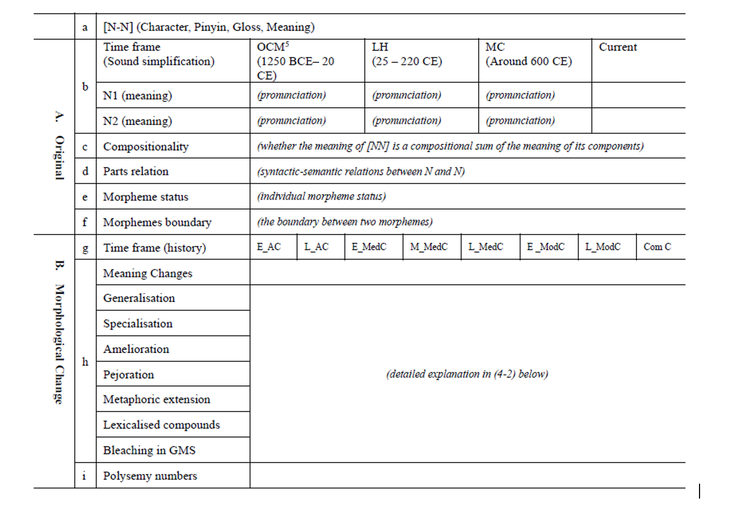
In the initial phase (Part A) of the analysis, the original properties of the remaining selected words and their constituent elements were examined, referencing both the ‘Great Chinese Dictionary’ (HDC, Lou 1993) and the ‘ABC Etymology Dictionary’ (Schuessler, 2006). Within subsection (a) of the table, an examination of the meaning of the original noun-noun words and that of each constituent element was undertaken, providing orthographic information, the meaning of words and the meaning of word constituents, as well as Pinyin information for pronunciation.
Subsequently, in subsection (b), initial emphasis was placed on providing reconstructed pronunciations of each constituent character across various time periods, both preceding and subsequent to phonological simplification. This was crucial due to the phonological simplification processes that occurred during the later AC period (206 BCE–220 CE) and the early MedC period (220 CE–587 CE). Despite the simplification of the internal syllable structures, the semantic value of a given character endures and is conserved within the language due to the predominant function of Chinese characters in denoting the meaning of morphemes, with the structural configuration of sinographs generally remaining stable once created.
In the subsections (c, d, e, and f) of Part (A), the primary focus was on the analysis of the morphological properties of the original words. This analysis encompassed an exploration of the meaning of the original words, assessing whether their meanings were compositionally derived from the meaning of their constituent elements, as exhibited in table (c). Furthermore, it included an analysis of the interrelation between two constituent morphemes, including the syntactic-semantic relations between two morphemes and the semantic relations between words and their components, as illustrated in (d) of the table. In addition, it entailed an exploration of the form of the original words, including the individual morpheme status, as displayed in (e) and the categorisation of boundaries between the two morphemes in (f) of the table.
Part (B) of Table 4 focused on the transformations in form and meaning that words underwent from their original states, as provided in Part (A). The study covered eight developmental periods, listed in the Time Frame row (g) of the table (see note 1).
Given the unique features of the Chinese character script and its correlation with morpheme and character representation, with subsection (h) of Part (B), an investigation was conducted to assess any alterations that contributed to the changes in the meanings of noun-noun words in Mandarin Chinese across different time periods. Moreover, subsection (j) of Part B provided information on the proliferation of polysemous words over the developmental periods.
This semantic analysis involves evaluating how a word's meaning can change significantly over time through various processes, which can occur in several ways.
This extensive analysis of individual noun-noun complex words was documented in a spreadsheet. This detailed dataset facilitated an in-depth analysis of the morphological changes in noun-noun words. It served to identify various types of alterations and shed light on the underlying mechanisms driving these changes. Additionally, this rich dataset allows for an exploration of the extent to which these changes conform to established models or present innovative patterns, as well as an investigation into whether semantic changes in Mandarin Chinese follow a distinct trajectory by accumulating additional meanings over time. Such a thorough analytical approach was crucial for effectively addressing the research inquiries.
Results and discussion
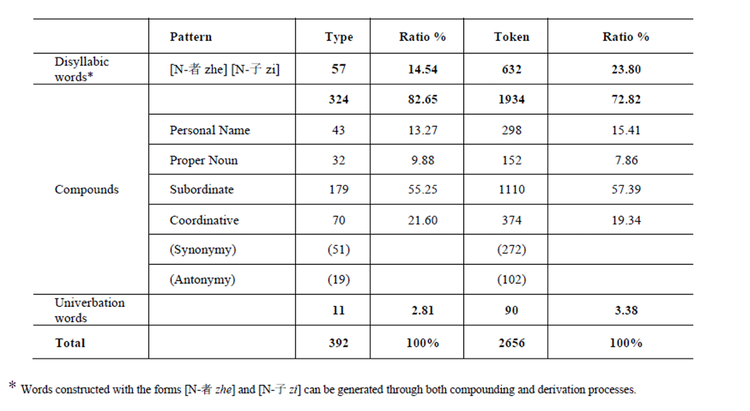
The distribution of 392 noun-noun words in early AC is given in Table 5, categorising them as compound words, derivational words, and univerbated words. These findings not only illustrate the emergence of complex words through various word-formation processes during earlier historical periods, but they also serve as a crucial basis for understanding language change in complex words. Crucially, these results offer a statistical baseline for comparison with later developmental data, which will help answer the second research question of this paper about developmental patterns.
Table 5 further details types and tokens for each noun-noun sequence within the early AC text of the SCC corpus. Within this table, personal nouns and proper nouns are classified as individual forms, both being the sub-categories of compounds. These proper nouns (excluding personal proper nouns) are structured either subordinately or coordinatively. Once formed, these proper nouns, including personal names, demonstrate relative stability both structurally and semantically, as mentioned in the data and method section.
Table 5: Distribution of 392 noun-noun words in early AC
The analysis of 392 noun-noun words from the earliest period of the SCC corpus reveals their various distributions across different structures, including derivatives, compounds, and univerbated words, as detailed in Table 5. The identification of various types of disyllabic words in earlier language development provides additional validation for Chanell’s (2019) research on the origin of disyllabic words in Mandarin Chinese.
It demonstrates that compounding served as the primary mechanism for creating new words. The use of compounds (excluding personal names) exhibits greater frequency than derivatives, with types (281 versus 57) and in tokens (1636 versus 632). This represents 61.89 per cent of total types and 52.84 per cent of total tokens for compounds, compared to 12.56 per cent of types and 20.41 per cent of tokens for derivatives, out of a total of 396 types and 2656 tokens.
This prevalence of various disyllabic word types challenges traditional beliefs stemming from the works of scholars like Karlgren (1926), Li (1993), Li and Thompson (1981), Pulleyblank (2000), and Wang (1958).
Regarding the semantic relationship between the two constituents of noun-noun compounds, the data shows that subordinative compounds were more prevalent, accounting for 55.25 per cent of the 324 total types and 57.39 per cent of the 1934 total tokens. In contrast, coordinative compounds represented 21.60 per cent of types and 19.34 per cent of tokens. The significant use of coordinative patterns in word generation during early AC deviates from Feng’s (1998, p. 215) proposition.
Feng suggested that coordinative combinations primarily served prosodic purposes, reinforcing the disyllabic foot rather than functioning as true compound words, often with one element losing its meaning. My findings indicate that both constituent components in coordinative compounds contribute semantic values.
These compounds, often formed from synonyms or near-synonyms, where the individual parts and the whole share very similar meanings, illustrate a clear relationship between the components and the overall meaning. The resulting compound typically expresses a superordinate-level meaning, commonly used in generalizing and collective contexts. This observation aligns with cross-linguistic findings by Arcodia, Grandi, and Wälchli (2010).
This is illustrated by instances such as父母 fù-mǔ father-mother, signifying ‘parents’, in (5-1), 兄弟 xiōng-dì younger brother-elder brother, denoting ‘brothers’, in (5-2), 子孫 zǐ-sūn child-grandchild, signifying ‘descendant’ in (5-3), and 君臣 jūn-chén ruler-minister representing ‘a ruler and his ministers’ in (5-4).
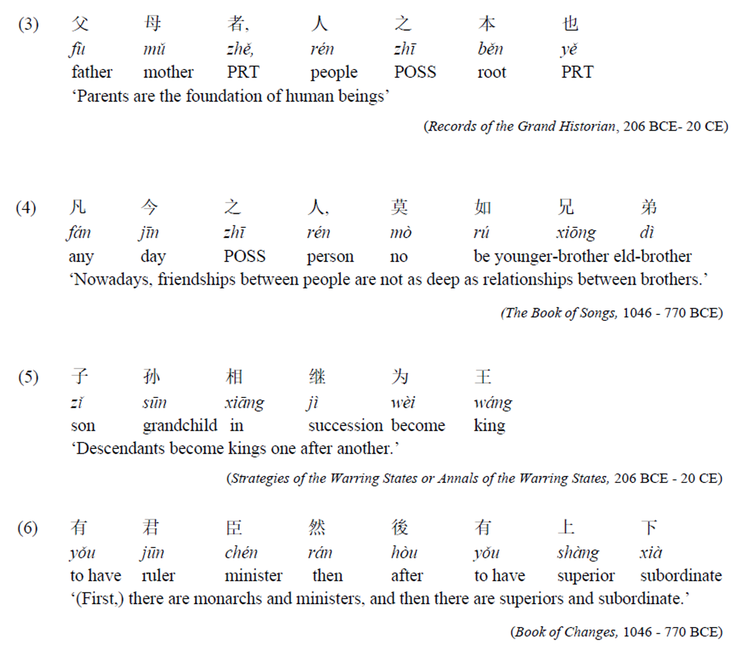
These coordinative compounds, found in the ancient texts of early AC, constitute empirical evidence that contradicts the theory suggesting that disyllabification in Mandarin Chinese results exclusively from phonological simplification. Furthermore, this study builds upon Chanell’s (2019) research by proposing a new perspective: that some disyllabic words were formed through univerbation. It is noteworthy, however, that the use of univerbated words was limited during the early developmental periods. My dataset identified only 11 such words, representing 2.81 per cent of the 392 total noun-noun types and 3.39 per cent of the 2656 total noun-noun tokens.
Concerning different types of meaning change among polysemous words, Table 6 presents three main types of meaning change found within noun-noun polysemous compound words. These encompass the compositional types (where meaning can be logically deduced from the constituent parts), the metaphoric and metonymic types, and the non-compositional types (where meaning cannot be inferred from the parts). My focus on subordinative and coordinative constructions is due to their higher frequency, as indicated in Table 3. This semantic analysis is based on the semantic relationships between compounds and their constituents.
Table 6: Different types of meaning change among polysemous compound words
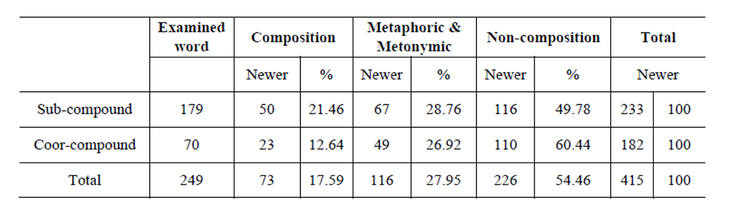
Out of the 415 newly developed meanings derived from the originally examined words, approximately 54.46 per cent exhibit an opaque meaning, while around 27.95 per cent show metaphoric or metonymic meanings. Although the meaning of metaphorical words may not directly correlate with the meaning of their components, the grammatical relationship between the parts remains clear. Merely about 17.59 per cent of the total newly developed meanings retain semantic transparency between compounds and their constituent elements, as demonstrated in Table 6.
When considering the types of polysemy and the development of new meanings, both subordinative compounds and coordinative compounds demonstrate similar distribution patterns across the three meaning types. The occurrences of non-compositional meaning compounds show a higher proportion, with subordinative compounds accounting for 49.78 per cent and coordinative compounds for 60.44 per cent This is followed by metaphoric or metonymic compounds at 28.76 per cent for subordinative compounds and 26.92 per cent for coordinative compounds. Compositional compounds have the lowest occurrence, representing 21.46 per cent of subordinative compounds and 12.64 per cent of coordinative compounds, respectively.
In relation to non-compositional types, coordinative compounds exhibit a higher preference in contrast to subordinative compounds of the same type of meaning change, reflecting an approximate 10 per cent disparity (60.44 per cent versus 49.78 per cent). The higher prevalence of new non-compositional meanings implies that lexicalisation (lexicalised compounds) is the principal process in acquiring new meanings in the Chinese lexicon. Given that non-compositional compounds contain lesser semantic information from their components, these words are considered lexicalised through the process of lexicalisation, in accordance with Brinton and Traugott (2005) and Packard (2000, ch.6). These findings align with previous research indicating that disconnected semantic relationships between compounds and their constituent elements can result in the compound taking on various meanings in different contexts (Downing, 1977, p. 811; Levi, 1978, p. 68; Ryder, 1994, p. 9; Scalise, 1986, p. 8).
Conclusion
This study presents a thorough analysis of the historical development of disyllabic noun-noun complex words in Mandarin Chinese. Distinguished by its corpus-based methodology, the research investigates a diverse array of historical texts to trace morphological processes and to analyse noun-noun constructions along with their components, highlighting how these changes contributed to shifts in meaning from AC to Contemporary Chinese. The investigation was guided by two central questions: (i) What types of disyllabic noun-noun words existed in early AC, and what were their word formation processes? (ii) Do the semantic changes in compounding words align with established models, or do they introduce new patterns through the accumulation of additional meanings over time?
To address these questions, this study has established a comprehensive classification system for affixes in Mandarin and integrated existing frameworks that elucidate the semantic relationships among constituent elements, as well as between compounds and their components. The data sources utilised for this research included historical dictionaries and various corpora, which led to several significant findings:
- The majority of the analysed noun-noun compounds were generated through morphological processes, with a predominant focus on compounding and derivation. Compounding served as the principal mechanism during the early AC period, while a smaller proportion of disyllabic words emerged due to univerbation.
- Three principal categories of semantic change have been identified: (i) non-compositional (opaque) meanings, (ii) metaphorical or metonymic meanings, and (iii) compositional changes encompassing broadening and narrowing. Among these categories, non-compositional meanings are the most prevalent, followed by metaphorical or metonymic meanings and compositional shifts.
- A significant finding is the distinctive pattern of semantic change observed in Mandarin Chinese, which is characterised by the accumulation of additional meanings through polysemy. This enduring trend frequently leads to lexicalisation, enabling the coexistence of both original and newly developed meanings. This observation is intricately connected to the Chinese writing system, which facilitates the preservation of meanings and significantly influences the way semantic changes occur in Mandarin.
This research presents a novel perspective on the historical development of noun-noun compounds in Mandarin Chinese. By emphasising the significance of morphology and semantics, this study enhances our comprehension of historical word formation and the evolution of meaning within the Chinese language. Furthermore, it contributes to the broader field of diachronic linguistics, advancing our understanding of the dynamics of language change over time.
Notes
2. A mora is a unit of syllable weight in phonology that helps determine syllable structure, stress, rhythm, and timing in various languages. It is distinct from a syllable and serves as a sub-syllabic unit, where different languages use morae to establish prosodic rules. It represents the smallest unit used in prosodic analysis. In the complex system of AC, the minimal syllable structure is CVC, and the maximal syllable structure is CCCMVCCC (C= consonant, V= vowel, M=medial) (Ting (1979: 717-736; Yu (1985, 290).
3. Univerbation is the process of creating a single word from an expression or construction that originally consisted of multiple words (Campbell, 2013, p. 258).
4. Texts and text types in early AC (The University of Sheffield, 2007)
5. Minimal Old Chinese (OCM), Later Han Chinese (LH), and Medieval Chinese (MC) refer to Schuessler’s (2009) reconstructions of three earlier stages of Chinese.
References
Adams, V. (2016). An introduction to modern English word-formation. Routledge.
Arcodia, G. F., Grandi, N., & Wälchli, B. (2010). Coordination in compounding. In S. Scalise & I. Vogel (Eds.), Current Issues in Linguistic Theory (Vol. 311, pp. 177–198). John Benjamins Publishing Company.
Baxter, W. H. (2010). A handbook of Old Chinese phonology (Vol. 64). Walter de Gruyter.
Brinton, L. J., & Traugott, E. C. (2005). Lexicalization and language change. Cambridge University Press.
Bybee, J. (2015). Language change. Cambridge University Press.
Campbell, L. (2000). What’s wrong with grammaticalization? Language Sciences, 23(2), 113–161.
Campbell, L. (2013). Historical Linguistics: An Introduction. Edinburgh University Press.
Chanell, J. (2019). A corpus-based study of N1-N2 words in archaic Chinese.
Chao, Y. R. (1968). A grammar of spoken Chinese. University of California Press.
Cheng, X. [程湘清]. (1982). 先秦双音词研究 [A Study of Disyllabic Words in Pre-Qin]. In X. [程湘清] Cheng (Ed.), 先秦汉语研究 [Studies of Pre-Qin Chinese] (pp. 44–112). Shandong Jiaoyu Chubanshe.
Downing, P. (1977). On the Creation and Use of English Compound Nouns. Language, 53(4), 810–842.
Duanmu, S. (2007). Phonology of Standard Chinese. Oxford University Press.
Feng, S. (1998). Prosodic structure and compound words in Classical Chinese. Trends in Linguistics Studies and Monographs, 105, 197–260.
Frege, Gottlob. 1893. Grundgesetze der arithmetik. Vol. 1. Verlag von Hermann Pohle.
Gillon, C., & Mailhammer, R. (2015). Reanalyzing the Morphology and Semantics of Verbal Plural Marking in Quechan. International Journal of American Linguistics, 81(4), 573–593.
Hatcher, A. G. (1960). An introduction to the analysis of English noun compounds. Word, 16(3), 356–373.
Haudricourt, A. G. (1972). Problèmes de phonologie diachronique (Vol. 1). Société pour l’étude des langues africaines.
Haudricourt, A.-G. (1954). De l’origine des tons en vietnamien. Imprimerie Nationale.
Hu, X., & McLaughlin, J. (2007). Sheffield Corpus of Chinese. University of Sheffield.
Jespersen, O., Christophersen, P., Haislund, N., & Schibsbye, K. (2006). A Modern English Grammar on Historical Principles: Volume 6. Routledge.
Joseph, B. D. (2020). Historical Morphology – Overview and Update. In The Handbook of Historical Linguistics (pp. 63–87). John Wiley & Sons, Ltd.
Karlgren, B. (1926). Philology and ancient China (Vol. 8). H. Aschehoug & Company.
Kiefer, F. (2002). Morphological analysis in comparison. Current Issues in Linguistic Theory Vol. 201. JSTOR.
Labov, W. (1987). 12. The Overestimation of Functionalism. Functionalism in Linguistics, 20, 311.
Lees, R. B. (1966). On a transformational analysis of compounds: A reply to Hans Marchand. Indogermanische Forschungen (1966), 71(1966), 1–13.
Lehmann, C. (2020). Univerbation. Folia Linguistica, 54(41–1), 205–252.
Levi, J. N. (1978). The syntax and semantics of complex nominals. Academic Press.
Li, C. N., & Thompson, S. A. (1981). Mandarin Chinese: A functional reference grammar. University of California Press.
Li, F. (1993). A diachronic study of v-v compounds in Chinese [Ph.D., State University of New York at Buffalo].
Lou, Z. (1993). Hanyu Da Cidian (The Great Chinese Dictionary). In Shanghai: Publishing House of The Great Chinese Dictionary. Shanghai: Publishing House of The Great Chinese Dictionary Hanyu dacidian chubanshe.
Mailhammer, R. (2013). Lexical and Structural Etymology: Beyond Word Histories. De Gruyter, Inc.
Mailhammer, R., & Smirnova, E. (2013). Incipient grammaticalisation: Sources of passive constructions in Old High German and Old English. Comparative Studies in Early Germanic Languages, 41–70.
Marchand, H. (1969). The categories and types of present-day English word-formation: A synchronic-diachronic approach. Beck.
McCarthy, J. J., & Prince, A. (1993). Prosodic morphology: Constraint interaction and satisfaction.
Packard, J. L. (2000). The Morphology of Chinese: A Linguistic and Cognitive Approach. Cambridge University Press.
Peking University, C. L. R. C. (2014). Center for Chinese Linguistics. Center for Chinese Linguistics PKU.
Pulleyblank, É. G. (2000). Morphology in Old Chinese. Journal of Chinese Linguistics, 28(1), 26–51.
Ryder, M. E. (1994). Ordered chaos: The interpretation of English noun-noun compounds (Vol. 123). Univ of California Press.
Sagart, L. (1999). Roots of Old Chinese. John Benjamins Publishing Company.
Scalise, S. (1986). Generative Morphology (Vol. 18). De Gruyter, Inc.
Schuessler, A. (2006). ABC Etymological Dictionary of Old Chinese. University of Hawaii Press.
Schuessler, A. (2009). Minimal Old Chinese and Later Han Chinese: A Companion to Grammata Serica Recensa. University of Hawaii Press.
Selkirk, E. O. (1982). The syntax of words. Linguistic Inquiry Monographs Cambridge, Mass, 7.
Taylor, J. R. (2002). Cognitive grammar. Oxford University Press.
Trips, C. (2017). Morphological change. In Oxford Research Encyclopedia of Linguistics.
Urban, M. (2015). Lexical semantic change and semantic reconstruction. In The Routledge handbook of historical linguistics (pp. 374–392). Routledge.
Wang, L. (1958). Hanyu Shigao [A Historical Account of the Chinese Language].
Warren, B. (1978). Semantic patterns of noun-noun compounds. Acta Universitatis Gothoburgensis. Gothenburg Studies in English, Goteborg, 41, 1–266.
Wu, Z. (伍宗文). (2001). Study on the Chinese polysyllabic words in Pre-Qin (先秦漢語複音詞研究). Bashu Publishing House.
Zhang, H. (1992). Topics in Chinese phrasal tonology [Ph.D., University of California, San Diego].
About the author
Dr Jane Chanell holds a PhD in Linguistics from the School of Humanities and Communication Arts at Western Sydney University, Australia. Her doctoral research, titled ‘A Corpus-Based Approach to Diachronic Morphology in Noun-Noun Compounds in Mandarin Chinese’, focuses on the intersection of morphology, semantics, and historical linguistics.
She also holds a Master of Research in Linguistics from Western Sydney University. Jane is deeply passionate about language studies, with particular interests in morphology, semantics, and historical linguistics.
Alongside her doctoral research, she has worked as a lecturer and tutor at Western Sydney University, where she has taught a range of linguistics subjects, including Introduction to Linguistics, The Sound of Language, Second Language Acquisition, The Meaning of Language, and Historical Linguistics.