Conceptual disruption of AI image generators within the creative process
Joshua Honeyman, Western Sydney University
Abstract
This paper examines the ways in which artificial intelligence (AI) image generators disrupt how images are created and viewed. It will consider how conceptual disruption, whereby AI image generators allow non-artists to easily generate digital images, and online images are reassessed for originality and truth. Conceptual disruption occurs where there is a conflict or uncertainty about the application conditions of a word or concept.
In this case, it occurs with the AI-generated images and the effect on how online images are perceived. The algorithm by which artificial intelligence image generators forms images often result in significant visual errors, which have been somewhat erroneously described as ‘hallucinations’. The paper examines and categorises types of AI hallucinations using a surrealist inspired dream matrix, within the notion of ungroundedness, and through an understanding of visual rhetoric.
The AI hallucinations are contrasted with intentional hallucinations in human made images, using the artworks from the fin de siècle-era Symbolist movement, where the artists created images relating to dream hallucinations and subconscious visions. Finally, AI image generators are explored as source material in the process of creating my own handmade images as part of my practice-led thesis research.
This process demonstrates how the types of AI hallucinations can be used as source material which points towards the potential and limitations of AI as a collaborative agent in the creation of visually compelling works. Through this analysis, an understanding of the disruption and creativity in the context of artificial intelligence with human imagination will emerge.
Introduction to Disruption Theory
The Cambridge dictionary definition of disruption says that the verb “to disrupt” can “prevent something, especially a system, process or event from continuing as usual or expected” (Cambridge University Press, n.d.); the Merriam-Webster dictionary defines disruption as “the act or process of disrupting something : a break or interruption in the normal course or continuation of some activity, process” (Merriam-Webster, n.d.). In day-to-day language disruption is normally connected to disturbance, disorder, turmoil, and even destruction (Hopster, 2021). Disruption implies a break or interruption to what is familiar, traditional or the status quo (Vollmer, 2013).
A conceptual disruption can be defined as that which alters how ideas, beliefs, classifications, and perceptions are viewed (Löhr, 2023; Marchiori & Scharp, 2024; Pather et al., 2024). A common cause of this type of disruption is new technologies, which change the thinking related to the implications of that technology. New technology in this situation can have the effect of introducing entirely new ways of doing things or seeing things. While this does not always mean an actual concept will change, it often means there is a disruption to a concept, causing it to be reevaluated and perceived in a different light (Löhr, 2023).
There is an economic understanding of disruption, as theorised by Clayton Christensen, which he called “disruptive innovation theory” (Hopster, 2021, p.1; Kilkki et al., 2018, p. 276). Typically, this is associated with cutting-edge technologies and business models which disrupt the existing order and bring some advantage through their introduction, especially in terms of financial and business success (Kilkki et al., 2018, p. 276). The term has its origins in the mid-20th century and the political economist Joseph Schumpeter, who coined the term “creative destruction”. Schumpeter wrote that capitalism is a form of economic change that cannot be stationary and that a process of constant mutation revolutionises the economic structure from within, destroying the old one, and creating a new one coining the term “creative destruction” (Levina, 2017, p. 549).
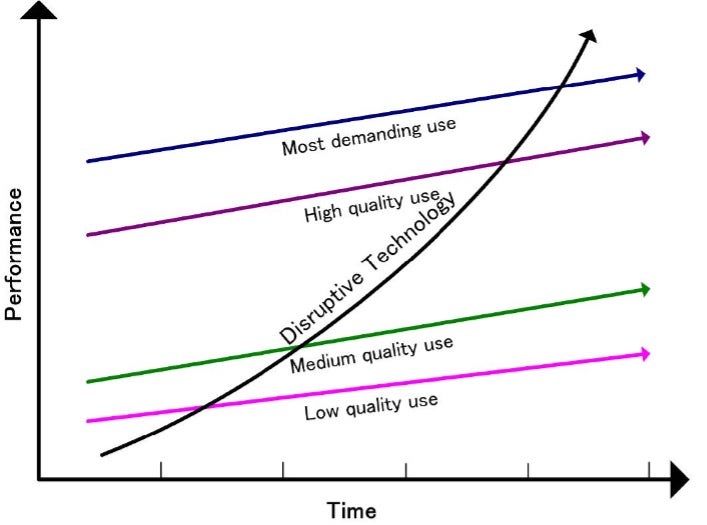
Figure 1: Innovative Disruption (Megapixie, 2005).

According to Christensen, there are two forms of disruptive innovation. The first occurring when a new cheaper product or service appeals to less demanding customers. Over time, it improves and moves up the market, eventually threatening established leaders. The second occurs where a whole new market is formed with a different value proposition than the existing one. This can make the existing market obsolete or force them to adapt significantly. Killki et al., (2018) defined this form of disruption as one that is slanted towards a business environment or system:
An agent is disrupted when the agent must redesign its strategy to survive a change in the environment. From the perspective of a system, a disruption is an event in which a substantial share of agents belonging to the system is disrupted. A disruptive innovation is a passive entity that mediates a disruption in a system (2018, p. 276).
An example of this is the evolution of the handheld digital camera, which not only replaced one hundred-year-old the handheld analogue film camera technology leading to the subsequent demise of film processing companies like Kodak, but was itself replaced by further developments including camera phones and smart phones (Kilkki et al., 2018, p. 280).
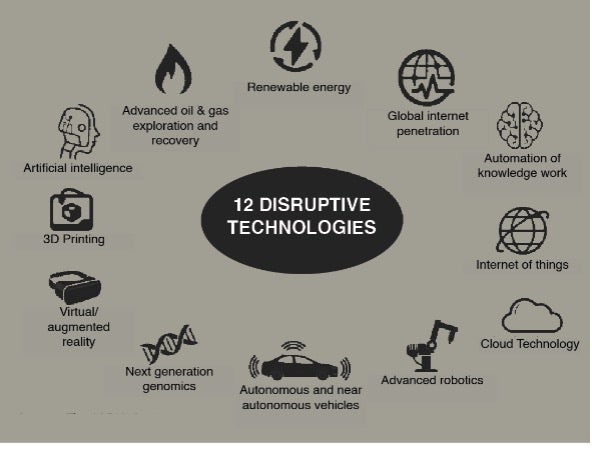
Figure 2: Twelve disruptive technologies (Preethika,2020).
Disruptive new technologies, such as artificial intelligence; genome editing, robotics, and virtual reality (see examples in Figure 2) are often flagged as disruptive technologies characterised by big societal promises, and deep anxieties (Hopster, 2021, p. 1). In this way, the positive connotations ascribed to innovative disruption is informative because it considers how change is not necessarily negative, and thus can impact and alter social norms, often in ways which would not normally occur (Kilkki, et al., 2018, p. 277).
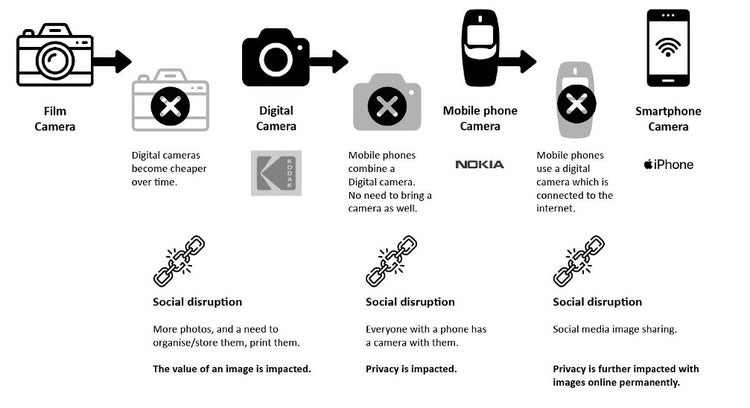
Figure 3: The disruption of digital cameras (Honeyman, 2024).
To illustrate this, we can consider the technological disruption of digital cameras. Digital cameras initially entered the market as a high-end product of professional photography. Since their introduction in 1994, ery quickly, digital cameras became widely available, rapidly became a low-end market product and lost monetary value.
Since that time, the digital camera has itself been supplanted by the mobile phone camera. Despite the phone camera being inferior to the digital camera in terms of picture quality and camera settings, the ease of use and availability meant that by 2008 the mobile phone manufacturer Nokia was the world’s leading producer of cameras. The technology around mobile phones further advanced due to the introduction of 3G networks, and the mobile internet connectivity resulted in the development and widespread use of smartphones further disrupting camera technology and severely impacting Nokia’s market dominance in cameras. The subsequent disruption caused by the digital camera in combination with mobile technology and the internet, resulted in far reaching changes in social behaviour and terminology, highlighted by using camera selfie photographs to document everyday social happenings and peer group behaviour – not just memorable events. (Kikki, 2018).
The importance of this timeline of technological progression, in terms of innovative disruption, relates to how the previous technology was supplanted or made obsolete by the new technology. In this case, the progression took place over a very short period. The advent of digital cameras in 1994 to the introduction of the smart phone in 2009 meant that leading businesses such as Kodak and Nokia had little time to adapt or change production and thus went bankrupt or were forced to significantly alter their business model
However, this view of disruption by innovation is generally less useful for understanding the more complex socially transformative dynamics, particularly as these pertain to creativity due to the disruptive effects of new technologies (Van de Poel et al., 2023, p. 16). To better understand how technological disruption impacts creativity a more philosophical framework around the concept of disruption needs to be explored.
AI and 'conceptual disruption'
According to professor of philosophy, Guido Löhr, a conceptual disruption is defined as:
… [a]ny intentional or unintentional challenge or interruption of the ways in which the individual or group has intuitively classified individuals, properties, actions, situations, or events, leading to classificatory uncertainty, i.e., uncertainty about the application conditions of a word or concept (2023, p. 3).
From this it can be deduced that conceptual disruption occurs when something new is encountered that does not fit within an existing understanding of the world. For example, this might be a new technology such as artificial intelligence image generators or a social phenomenon, such as the concept of family which is altered by LGBTQ+ legal rights or even a scientific discovery, such as the theory of evolution. In each case, there is a disruption, where the new concept no longer fits easily within the existing conceptual framework, and thus requires a revaluation or a completely new definition.
Hopster et al., (2023) succinctly defines a conceptual disruption as “a challenge to the meaning that prompts a possible future revision of it” (cited in Marchiori & Scharp, 2024, p. 143). A conceptual disruption generally occurs because of a significant social disruption, though not all social disruptions will have a conceptual impact (Tavory& Fine, 2020, p. 373; Vollmer, 2013, p. 2). A social disruption is further defined as a situation which challenges the established natural boundaries, social categories, and conceptual schemes because disruptions rarely come from within a social system and are instead usually forced upon it from an external stimulus (Hopster, 2021, p. 2). These social disruptions can result in a period of deep uncertainty and confusion as they “unravel the normative, theoretical, and conceptual threads of social conduct” (Marchiori, & Scharp, 2024, pp. 1-14; Van de Poel et al., 2023, p.17). In response, social disruptions can begin a process of reflection and reorientation. They can force an engagement with new philosophical and ethical viewpoints, and even a revaluation of the specific concepts and perceptions surrounding the implications of the disruption (Van de Poel et al., 2023, p. 17). In this way, it can be said that a significant social disruption can have a conceptual response (Pather et al., 2024, pp. 64–65).
Conceptual disruptions also vary in terms of significance. For example, the conceptual changes within image making because of artificial intelligence image generators, are likely to have more impact on people of the younger generations , the so called ‘digital natives’ (Prensky, 2001 as cited in Dingli & Seychell, 2015, p. 9), than on the older generations who tend to have less reliance on, or are less influenced by digital devices and the internet.
To illustrate conceptual disruption, Löhr provides an example, in which the future personal use of artificial intelligence robots will not only impact our social practices and norms regarding trust, but challenge or even alter our conception of trust (2023, p. 1). While we usually apply the concept of trust only to people whom we are relatively close to, or at least those within the same social group, we may soon apply it to robots and other intelligent non-human systems (Löhr, 2023, p. 1). As Löhr points out, the idea of trust is especially complicated if robots are conceptualised and defined as ‘legal’ persons (2023). These disruptions not only change the concept of personal identity but also challenge the concept of life itself due to definitions about synthetic biology (Löhr, 2023, p. 2).
Hopster et al., (2023) set out a framework that explores conceptual disruption in three forms (see Figure 4). Beginning with the conceptual gap, where there is a lack of the:
… concepts used to describe a novel technological artifact, or to normatively evaluate the new impacts and affordances to which it gives rise (Hopster et al., 2023, p. 144).
A conceptual gap considers that there is a significant disparity or discontinuity between different conceptual frameworks or sets of concepts.
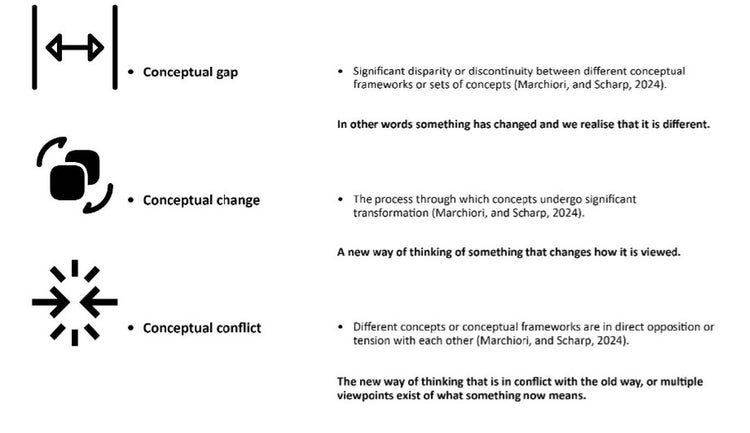
Figure 4: Conceptual Disruption (Honeyman, 2024).
In other words, something has changed, and the new thing has features that are different enough that it does not fit into existing categories. An example of this can be seen in the way artificial image generators disrupt the idea of creativity, as creativity pertains to being a defining human only trait. There is a conceptually disruptive gap in terms of what the new definition of a non-human creative agent is.
The second type of conceptual disruption lies within what Hopster et al., (2023) refer to as the conceptual overlap or conflict. This occurs when different concepts, or conceptual points of view, are in direct opposition or tension with each other (Hopster et al., 2023, p. 144). This can be taken to mean that a new way of thinking conflicts with the old way, or that multiple viewpoints exist as to what something now means. An example of conceptual conflict can be found when artificial intelligence is categorised as an artist or creative image maker, and this creates a tension between human and artificial intelligence creativity, and what an artist is and whether in fact, artificial intelligence should be thought of as an artist (Wingström et al., 2022, p. 180). Another conceptual conflict is apparent when the creative outcome can be seen in the form of a tangible physical artifact, such as a painting or a song, and this is compared to an intangible outcome such as online image which has been produced by artificial intelligence (Wingström et al., 2022, p. 180). The online image, created using artificial intelligence, may not actually exist in the real world, nor can it easily claim distinct authorship.
Creativity and 'conceptual disruption'
The idea of creativity itself is in conceptual conflict when the need to assign the ability of producing unique ideas and behaviours is equally possible between a human artist or a non-artist human, or the artificial intelligence itself. Formally, artworks were created by artists, often with years of training or something akin to talent or skill. Now, a non-artist human with no training and no apparent talent can produce something using artificial intelligence, which could be claimed as an artwork (Wingström et al., 2022, pp. 179-180). Either the online artificial intelligence image is accepted as a legitimate creative outcome, equal to a traditionally created physical artefact, or it remains in conceptual conflict. The conceptual conflict here is sufficiently pronounced to require a conceptual change in how an outcome is viewed.
The third type of conceptual disruption is conceptual misalignment or change. This refers to the process through which concepts undergo significant transformation (Hopster et al., 2023, p. 144). This can manifest itself as a new way of thinking about something, which in turn changes how it is perceived. An example of this is finding a resolution to the artist/non-artist/ artificial intelligence conceptual conflict, which allows for the perception of creativity, art, and artist to change in a way that is understood and accepted in a social sense. The scholar Mark Coeckelbergh (2023) writes about conceptual change and questions whether artificial intelligence can be defined as “creative” during the process of making an image. On the one hand, the process involves an algorithmic code, which at best only simulates creativity and in which artificial intelligence lacks artistic intentions, imagination, and authenticity (Coeckelbergh, 2023, p. 4). However, Coeckelbergh (2023), considers that simply by simulating creativity, the result could be said to be a new artwork. Thus, artificial intelligence is creating a conceptual change in how art is defined, that it is not only humans that can be creative, and that a simulation of creativity can generate art.
Analysing these types of conceptual disruptions illustrates how artificial intelligence image generators are altering the meanings and classifications of ideas around image making, such as creativity, process, outcome and audience (see Figure 5). This examination allows a better understanding of artificial intelligence image generator’s roles in disrupting the social relations around the human artist, non-artist human and non-human artificial intelligence software.
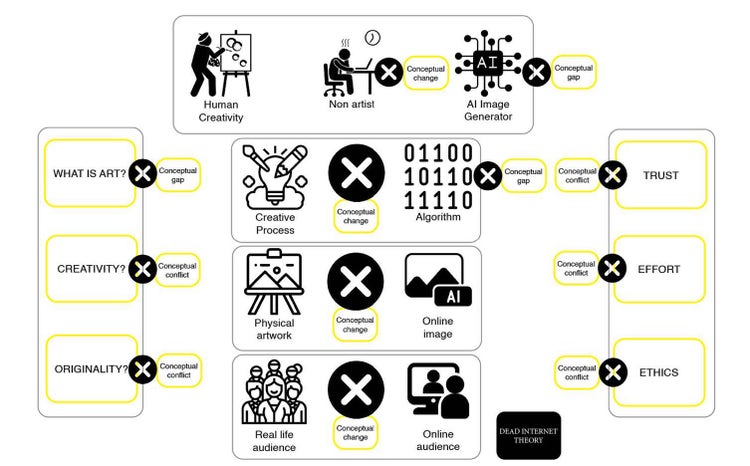
Figure 5: The conceptual disruption of artificial intelligence image generators (Honeyman, 2024).
The conceptual disruption caused by artificial intelligence image generators is due to the significant changes in the way images are created, manipulated, and understood.
Professor of English Literature, Echart Voigts defines artificial intelligence as “a simulation of human intelligence processes by computer systems” (2021, p. 290). Artificial intelligence might be a reactive machine (such as a chess game simulator) or a limited memory machine, such as a self-driving vehicle. Voigts (2021) notes that, as yet, a self-aware machine, or one which understands “otherness” such as beliefs, desires and intentions, does not exist. Further, as Professor Roland Meyer explains, artificial intelligence can create entirely new images by drawing from a vast archive of online imagery (2023). This process requires only a few words as input, eliminating the need for further human interaction, creative or otherwise.
The aestheticisation of imagery in the form of stylised content is what Meyer (2023) calls a transformed, de-hierarchised, and inclusive notion of ‘style’: where images are made from the patterns that emerge from the aggregation and analysis of large ensembles of images. The scholar, Oscar Neggers’ (2023), survey of design professionals who use artificial intelligence is informative in terms of how artificial intelligence is used and some of the issues to do with stakeholder trust and workflow disruption. A similar study by Hyung-Kwon,et al., (2023) interviewed visual artists and found that artificial intelligence tended to play a minor role in most creative practices. The reason being that few artists had found a way of incorporating artificial intelligence into their creative process. Mazzone and Elgammal (2019) write about the creative process as a conceptual approach using artificial intelligence image generators where the artist is a curator of the input, tweaking what the computer is creating.
Artificial intelligence image generators are having a significant impact on artists and graphic designers, particularly in terms of altering how image makers choose to navigate the ethics and risks of using artificial intelligence (Hutson & Harper-Nichols, 2023, pp. 55-60). As Van de Poel et al., (2023, p. 16) point out, the disruption is significant due to the way artificial intelligence affects strongly held values and beliefs, core concepts, theories, norms, institutions and human capabilities pertaining to creativity and art.
AI and 'creativity'
Wingström., et al., (2022, p.180) discuss how artificial intelligence is used in tasks that require problem finding and solving, where artificial intelligence functions as a co-creator with a human, for instance as an interactive inspiration in a sketching task Image makers, such as designers and artists, are going to be affected by the disruption depending on whether they are replaced or made to learn to collaborate with the artificial intelligence within that industry (Tedre & Vartiainen, 2023, p. 3; Wingström et al., 2022, pp. 182-183). Since disruptions involve a “disruptor”, or something which creates the disruption and is the object of disruption, an artificial intelligence image generator is a disruptor in the sense that it is creating a supposedly original image with algorithmic code, rather than a human using creative imagination (Tedre & Vartiainen, 2023, p. 6; Van de Poel et al., 2023, p. 17). If a defining aspect of creativity could be reduced to the ability to produce unique ideas and behaviours (Glaveanu & Kaufman, 2019, as cited in Wingström et al., 2022, p. 179), then it could be argued that artificial intelligence is also creative, since it is a “cogniser”, or an “actor” that can autonomously pursue a goal and is thus able to decide upon, and make something unique (Wingström et al., 2022, pp. 179-180). This then has a disruptive effect, in which the concept of artistry and how an artist is defined is itself challenged.
Traditionally, creating images required human artists with expertise in various techniques such as painting, photography, or graphic design. With artificial intelligence image generators, the role of the artist shifts to that of a curator or supervisor, potentially someone without any expertise where the artificial intelligence is guided by a text input rather than actual human creativity. This can devalue the role of truth in art and raise questions of what constitutes art, and cause conflict with those who have expertise. The increasing availability and integration of artificial intelligence image generators raises ethical and societal concerns regarding the authenticity and manipulation of visual content. With the ability to generate highly realistic images of people, objects, and scenes, there's a risk of misinformation, identity theft, and privacy breaches. Additionally, issues of copyright and consent of the use of artists work for training the artificial intelligence is problematic..
AI 'hallucinations'
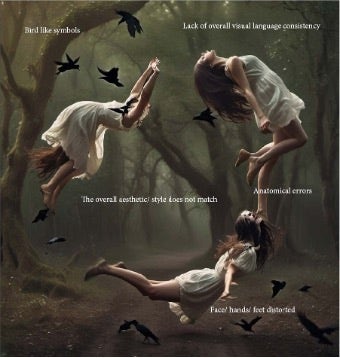
Figure 6: AI image #1 Artificial Intelligence Hallucinations (Honeyman, 2024).
The algorithm in which artificial intelligence image generators form images often result in significant visual errors, which have been somewhat erroneously described as hallucinations (see Figure 6). The origins of the term ‘hallucination’ in computer terminology trace back to Baker and Kanade (2000), and their more positive use of the term vis-à-vis computer vision describing how an algorithm “hallucinates” pixels to enhance images. Artificial intelligence is favorably associated with filling in digital information that is missing from images. While “hallucination” has these now negative connotations, positive origins suggest that artificial intelligence making up information is not definitively “good” or “bad”, but rather complicated (Halperin & Lukin, 2024). An example might include a low-resolution image that has been rendered in such a way as to have greater clarity by artificial intelligence hallucination being used to generate additional pixels to improve the image quality (Maleki et al, 2024).
More commonly, an artificial intelligence hallucination is considered as a negative attribute. It is an unwanted, even uncontrollable and unavoidable aberration added by the artificial intelligence image generator. Lu et al., (2024) describe artificial intelligence hallucinations as “the phenomenon where those models misinterpret visual data, often leading to erroneous or nonsensical outputs.”. Artificial intelligence hallucinations can be due to a text prompt not being specific enough or worded in such a way as to leave too much open to the artificial intelligence’s interpretation (Gunjal et al., 2024, p.1; Halperin & Lukin, 2024, p. 3). The details of the prompt can be inaccurate, such as asking for a “realistic photo of a fox in water”, might result in an image where the fox is impossibly walking on water. Such an image would include fabricated elements which defy laws of physics, something which isn’t correctly understood by artificial intelligence. Though as Professor of Semiotics Massimo Leone explains, this problem relates to how artificial intelligence can recognise what a fox looks like in photos, but not what a fox is in terms of the intricate relationship and fundamental differences between machine-learning methodologies and humanistic theories of meaning (2024). The "hallucination" metaphor in artificial intelligence from this perspective is a misnomer, as artificial intelligence lacks sensory perceptions, and errors arise from data and prompts rather than the absence of stimuli (Maleki et al, 2024). The metaphor of a hallucination is also highly stigmatizing, as it associates negative issues in artificial intelligence with a specific issue in mental illness, particularly schizophrenia, thereby possibly undermining many efforts to reduce stigma in psychiatry and mental health (Maleki et al., 2024).
Gunjal et al., (2024) write about being able to reduce hallucination by various methods of up to 57 per cent. However, their findings conclude that the issue is dependent on artificial intelligence bias and the size of the dataset and that unless the artificial intelligence training data is specific the problem of artificial intelligence hallucinations remain. Han et al., support these findings with artificial intelligence bias being a major contributing factor and more research being needed to examine if this bias can even be overcome at all (2024).
Artificial intelligence images can also be misleading, such as historical events or images based on real life facts, where the image is inaccurate or has errors in details and participants and has been termed “synthetic media” (Cole, 2024, p.95). Yang et al., (2023, p. 1) refer to synthetic media as the “data generated by computer algorithms or simulations as an approximation of information gathered or measured in the real world”. The available and ease of use of artificial intelligence image generators allows almost anyone to easily produce “synthetic visual versions of history” (Cole, 2024, p.95). Synthetic media goes beyond previous doctored or altered historical images, instead allowing completely new and unseen images.
As Cole (2024) writes, synthetic media has the potential to allow for previously unheard voices, such as marginalised communities to visualise history, and conversely the ability to recreate or rewrite history for politically nefarious reasons. The artificial intelligence model can also be using biased data or generate images which perpetuate stereotypes of generalisations such as gender bias (Gorska & Jemielniak, 2023), racial bias (Yang, 2025), and bias around portrayal of emotions and appearances (Zhou et al, 2024).
There is a further concern that artificial intelligence is being trained on images from the internet which are also artificially generated The “dead internet” theory (Muzumdar et al, 2025) holds that errors within artificial intelligence images are being amplified by the artificial intelligence being trained on images which already include artificial intelligence generated images. Significantly, it is easy to surmise how these issues are linked and compounded with respect to the possibility of inaccuracies, misinformation, stereotypes, bias, and misrepresentation of images potentially flooding the internet and visual communication platforms.
AI and the 'Dream Matrix'
Halperin and Lukin (2024) discuss these types of artificial intelligence image failings, where generative artificial intelligence is used for visual storytelling to both create the text and matching images. The study found the use of artificial intelligence had errors in matching these visuals with the artificial intelligence-generated story.
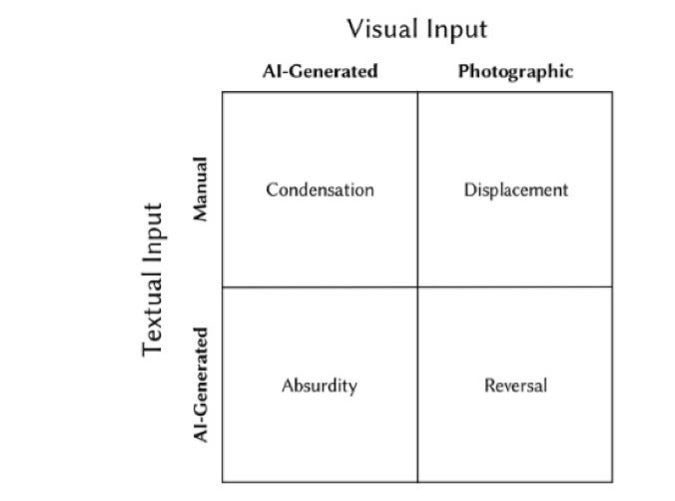
Figure 7: Dream Matrix (Halperin & Lukin, 2024).
Halperin and Lukin’s study referenced 1920s surrealists (Andre Breton, Hans Arp etc.) who practiced automatic writing and visualising with hallucinatory expression in the neuropsychological sense. Halperin and Lukin (2024, p. 624) define the four elements of the matrix as: Condensation, Displacement, Absurdity, and Reversal (Figure 7), and these are defined as follows:
- Absurdity is an image which is completely ridiculous such as that which might occur in a dream.
- Reversal is when two entities / elements are in reverse roles.
- Condensation is when two or more disparate elements are compressed into one signifier.
- Displacement is when a signifier (a person, event, or object) stands-in for and displaces, another signifier.
AI and 'groundedness'
Halperin and Lukin (2024, p. 624) write about the idea of “groundedness” in the context of their artificial intelligence-generated visual storytelling study. Groundedness refers to the extent to which the narrative elements (such as characters, events, and objects) in the generated story are related to, or derived from, the visual and textual inputs provided to the artificial intelligence system.
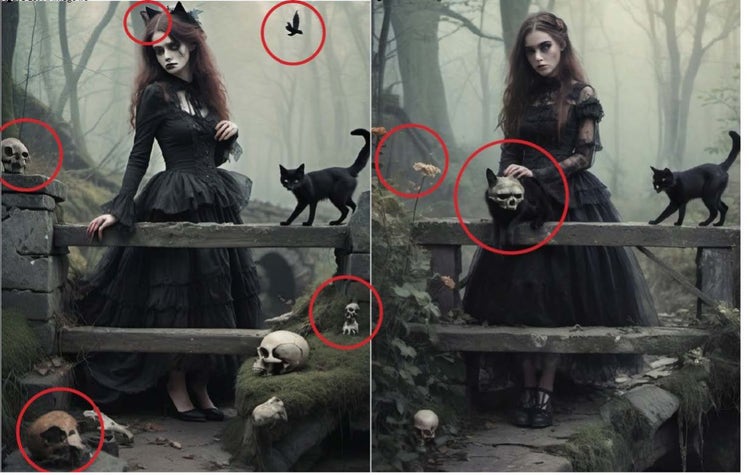
Figure 8: AI Image #2 (Honeyman, 2024).
As shown in Figure 8, the artificial intelligence, hallucinations are obvious errors, and lack intent, connection and groundedness to the prompt examples of artificial intelligence hallucinations across two similar images from the same prompt set out below:
A deathly pale woman in an old tattered torn dress standing on an old broken stone bridge with a cat nearby in a forest with a skull, there is also a fox, and a crow, and a black cat, and toadstools, Cottagecore style, gloomy magical atmosphere, gothic art, a colorized photo (Stable Diffusion, OpenArt SDXL).
The hallucinations shown in Figure 8 include a disfigured hand, disfigured skulls, symbols of a bird, a skull face cat, a three eyed cat, and a cat with five legs. As a visual image, the artificial intelligence hallucinations are obvious errors, lacking intent, connection and groundedness to the prompt. Artificial intelligence is unable to understand that the bird symbol is not the same as a more realistic depiction of a bird, or that a symbol of a bird in an otherwise hyper real image is visually inconsistent (Halperin & Lukin, 2024).
Halperin and Lukin determined that the artificial intelligence in their study invariably lacked groundedness, and thus “ungroundedness” resulted from the artificial intelligence output having has little or no relationship to the visual or textual inputs (2024). Therefore, by ungroundedness, we mean instances where an artificial intelligence-generated story (the system output) has little or no relationship to the visual or textual inputs.
Groundedness is discussed by Halperin and Lukin (2024, pp. 625–627) in terms of three types of partial groundedness:
- Mismatch: This occurs when the story is grounded in either the textual input or the visual input, but not both. As such, a story might accurately reflect the textual input but fail to align with the visual input, or vice versa. For example, in Figure 8, the cat with the skull — both are prompted textually, however visually these are an error.
- Misrecognition: This involves mistaken detection or interpretation of elements in the visual input, leading to a story that is grounded in these misinterpretations. For instance, if artificial intelligence misidentifies an object in the image, the resulting story might be based on this incorrect identification. For example, in Figure 8, the different sized and shaped skulls which implies the skulls belong to something unrecognisable.
- Leaps: These are extrapolations or inferences that go beyond the provided inputs. While these elements are not directly grounded in the inputs, they may still be reasonably inferred or associated with them, adding a layer of creativity to the story. For example, in Figure 8, the cat ears on the woman or the flowers beside the gate.
Thinking about artificial intelligence hallucinations in terms of conceptual disruption, exposes a gap in the understanding of the visual errors generated in artificial intelligence images. Whereas the result may seem to be a mistake, it is actually part of the way artificial intelligence generates images. This requires a conceptual change in how to view artificial intelligence images where the hallucinations are algorithmically correct and not a mistake or an intended visual component of the prompt output. Where a human might intentionally create a visual error, or make an anatomical error due to level of ability, the artificial intelligence does not know it is making a visual error. This creates a conceptual conflict between how humans perceive an error and how the artificial intelligence generates images. To understand this conceptual disruption in image making, it is useful to consider some of the underlying visual rhetoric behind why a human will create an image
AI and visual rhetoric
Rhetoric, according to the Oxford English Dictionary, is the art of effective or persuasive speaking or writing. Professor Leslie Atzmon defines “visual rhetoric” as pertaining to how visual objects inform and persuade in unique ways (2006). This is an essential aspect of visual communication which typically reflects an array of cultural themes. When expanded to include an actual image or object, visual rhetoric refers to the way visual symbols are appropriated for the purpose of communicating. This does not mean obvious or blatant persuasive information. Rather visual communication reflects an array of cultural themes. The images or objects become visual artifacts, involved in the generation of cultural belief systems, which according to Atzman (2006) is a profoundly rhetorical function.
Artificial intelligence excels at interacting with humans in terms of recognising images, but when asked to produce images with the same criteria, there is often an issue in the way AI understands or identifies a certain object even with a partial misunderstanding this leads to errors (Leone, 2024). For instance, the initial process layers of artificial intelligence might detect edges and corners, and even more complex shapes and objects, similarly to the way in which Gestalt theory describes the human visual system’s ability to perceive whole forms and patterns from basic visual stimuli (Leone, 2024). However, the AI of pattern recognition does not inherently involve the production of meaning or context in the same way human cognition does (Leone, 2024). It is this lack of understanding in terms of cultural meaning, the existence of emotion and ideas pertaining to meaning and intent which shows how artificial intelligence lacks visual rhetoric.
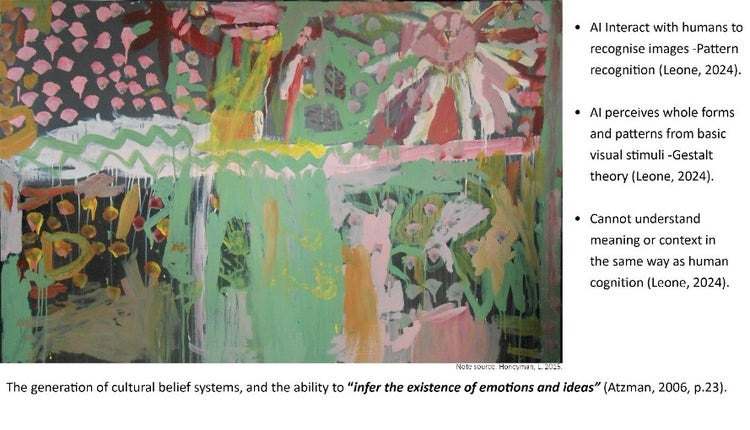
Figure 9: Ducks walking to the park (Honeyman, 2024).
An example of the way in which emotion and cultural meaning are intrinsic to human creativity can be seen in an image of a painting created by a five-year-old girl, in which she depicts an abstracted narrative where she imagines ducks walking to a pond in a park (see Figure 9). The ducks are represented by culturally appropriate yellow paint splodges and a large yellow “D”. The journey of the ducks is conveyed by a zig zag line pattern, passing by pink splodges (flowers) through areas of green paint (the park). The symbols and abstracted representation of objects in a narrative are an example of visual rhetoric available to a child based on their cultural upbringing and imagination.
While visual language such as this is learnt behaviour for a human child, the artificial intelligence image generators are unable to understand the role of culture and the abstraction of symbols in producing images. In short, artificial intelligence image generators cannot create images with visual rhetoric. The hallucinations produced by artificial intelligence are not intentional or necessarily designed to alter the meaning of an image in the way a human might use visual language. Hallucinations are a mistake which artificial intelligence is incapable of recognising.
This contrasts with hallucinatory images in human art. The conceptual disruption occurs due to the necessity to understand that artificial intelligence is not creating images the way a human is able, rather it generates a disturbing and uncanny imitation (Kishnani, 2025).
Art hallucinations
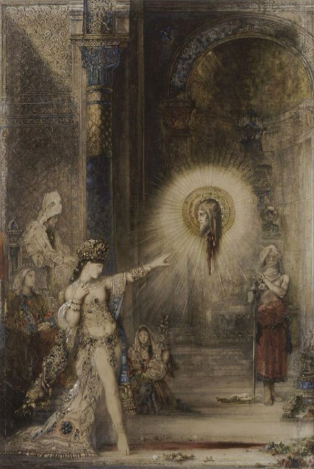
Figure 10: The Apparition (Moreau, 1876).
The concept of 'hallucinations' in art became most prominent during the late Victorian era, with advances in psychoanalysis along with a general sense of social anxiety and a reaction to the realism art of the Romantics. The new knowledge of how the unconscious mind works from psychoanalysis, along with technological advances such as x-rays, improved optical equipment in microscopes and telescopes, deep-sea diving and the boom in amateur photography. This resulted in an increased awareness that the human eye and rational mind was not telling the full story. X-rays, for example, sent invisible light through flesh, allowing the unseeable skeleton to be shown. Concentrated invisible light rays that could penetrate flesh and produce a visible image of the skeleton must have seemed horrifyingly unreal (Atzmon, 2006), presenting new ways of seeing changed previously accepted concepts of reality. If inventions such as x-rays allowed the intangible and invisible workings of the universe to be seen, what else was being missed by the human eye? The art movement known as the Symbolists were particularly interested in hallucinatory and dreamlike visualisations, in which the mind conjures up shadowy, esoteric worlds.
The images frequently bear resemblance to reality, which was an important part of the creative process and the belief that hallucinations externalise the internal machinations of the unconscious mind, producing bizarre combinations of visuals not based in rational thought (Atzmon, 2006). The unconscious mind was the link between the visible and the invisible realms.
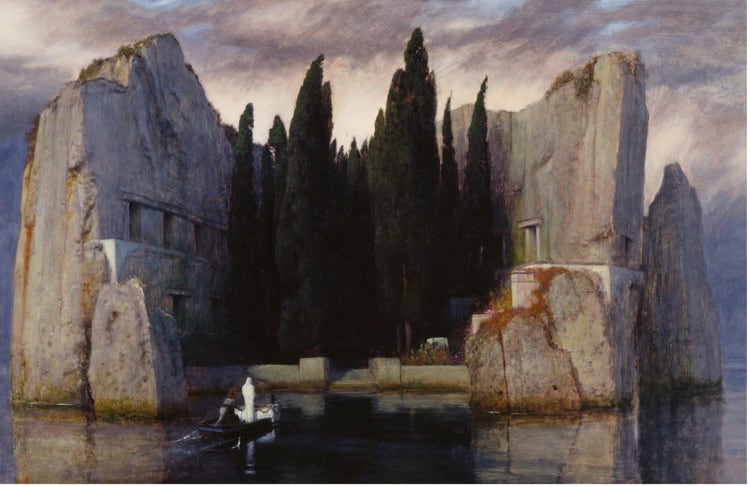
Figure 11: Isle of the dead (Böcklin, 1883).

Symbolist painters like Arnold Böcklin and Gustave Moreau (see Figures 10 and 11) took refuge in creating works based on myths and legends. Working from the confines of their studios, they created escapist and imaginary worlds (Mathieu, 1990, p. 14).
Another Symbolist artist, Odilon Redon (Figure 12), aimed to create a window into other worlds. Redon was clear about his intention to create work that explored the nature of dreams, visions, and otherworldly realities. Redon considered his work as existing in two worlds: that of daylight and nature, and that of the night and its dreams. Redon viewed the subconscious world of dreams as just as real as the conscious reality of the waking hours and believed that the world of dreams was merely another world with which to find expression. Redon sought to make this world of the invisible just as visible as the waking world (Berman, 1970, p.73).
In Redon’s work there is a clear "groundedness" in the visuals of dreams and inner visions/ worlds (Halperin and Lukin, 2024). The groundedness for an artist occurs since the work is coming from a place of meaning. For Redon this was dreams and inner visions/worlds.
All of my new creation consists of bringing to life the most improbably creatures in accordance with the laws of probability, using wherever possible the logic of the visible in the service of the invisible (Rathke, 2007, p. 51).
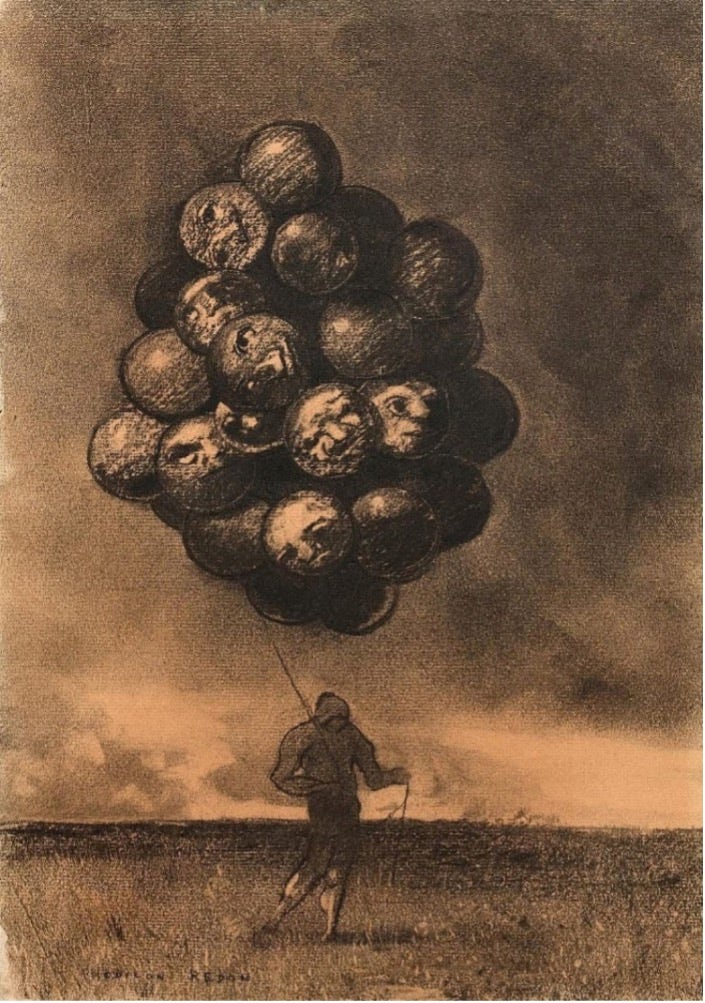
Figure 12: La grappe ou le marchand de ballons (Redon, 1906).
Redon’s hallucinations are closer to the biological meaning of the word as opposed to an algorithmic process. The human image maker has clear intent, a visual consistency, and a “groundedness” (Halperin & Lukin, 2024). Visual rhetoric is structured conscious awareness of culture and implicit meaning of what the images are saying. Redon’s visual rhetoric informs or reminds the viewer that there are things which cannot be seen by the rational waking mind and that hallucinatory visions in dreams exist, at least in the unconscious mind. Redon’s painting “La grappe ou le marchand de ballons” from 1906 (see Figure 12) is a visual representation of a hallucinatory image, a disquieting vision of a figure walking with the balloon like objects. Some of the balloons have distorted faces. The overall effect is an uneasy interpretation of reality, a balloon vendor with his balloons. When Redon wrote about “bringing to life the most improbably creatures in accordance with the laws of probability” (Rathke, 2007, p. 51), he created hallucinatory yet plausible visions of reality.
Redon was very much aware of the change’s new technologies such as photography and x-rays made to visual awareness and the language of “seeing” (Rathke, 2007). While photography was able to document and provide accurate information about reality, it could not do the same for unreality. Redon wanted to fill in the gaps and visually describe what the camera was unable to capture.
AI image generators in creative practice: A personal reflection
One of the defining aspects of my professional art practice has been my engagement with technology as part of the process of making images. At art school in the mid to late 90s, I was making photo collages of different imagery as source material for drawings and paintings. This involved heavy use of a new software program by Adobe called Photoshop. My interest in Photoshop lay in the ability to relatively easily alter photographic images, such as adding or removing parts of the image, and the ability to resize parts or change the colour, tone, or shape of parts of the image. These images could be very different from the original and sometimes became layered montages that could then be used as source material for handmade paintings and drawings. The painting process built on the initial montage, often changing it significantly.
While this approach was not really anything new, 1970s pop artists such as James Rosenquist and the 1980’s artist, David Salle, were two of the most important and influential artists for my work at this time, (whose work featured juxtaposed pictorial elements in their visual compositions). My creative practice remained largely unchanged, at least in terms of the use of Photoshop, until the recent advent of artificial intelligence image generators.
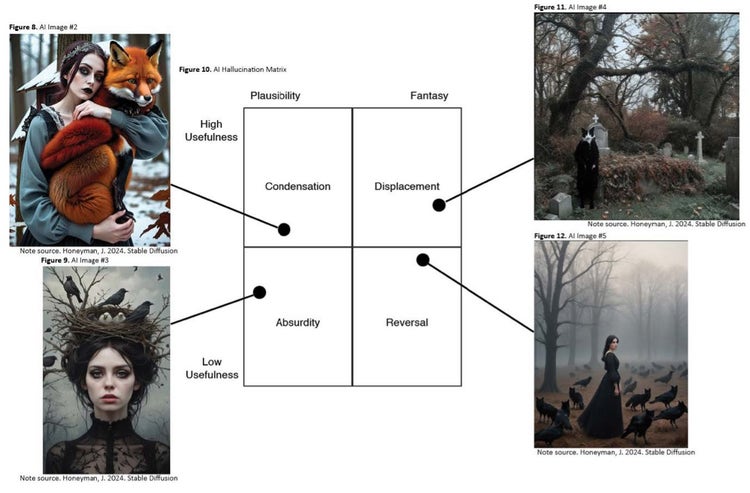
Figure 13: AI Matrix (Honeyman, 2024).
I have been categorising the hundreds of artificial intelligence images generated and the various types of artificial intelligence hallucinations using my version of the Halperin and Lukin dream matrix (see Figure 13). The hundreds of images generated were sorted into separate folders according to where I perceived them to fit in the dream matrix. In this way I was able to determine the usefulness of each image as source material in my own creative practice.
In this sense the artificial intelligence replaces the way I was using Photoshop, though the difference is the source material begins with the lack of groundedness and visual rhetoric, which tended to occur in my previous techniques of using photoshopped images. I was curious about the ways in which artificial intelligence image generators might disrupt my technique and whether artificial intelligence image generators would offer enough to my creative process to replace the Photoshop montage source material.
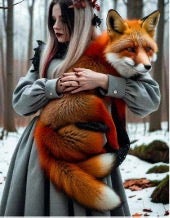
Figure 14: AI Image#3 (Honeyman, 2024).
Consider the image above (Figure 14). The artificial intelligence hallucination for the prompt of a girl carrying a fox in a forest that includes condensed hands (Halperin & Lukin, 2024) and the fox’s fur and tail. The scale of the fox tends toward absurdity (Halperin & Lukin, 2024), with the creature being much larger than a real live fox. These issues in an image which purports to be photorealistic are unacceptable. However, if this was to occur in a handmade image, such as a painting made by a human, the creative intent would allow for the image to be viable. In this was there is a visual dissonance in artificial intelligence imagery which need not be applied to images made by a human.
The following examples give some indication of the strengths and weaknesses of artificial intelligence image generators as a source material for handmade paintings. In Figures 15 to 19, the top left image is the AI-generated source material. From this I hand draw a sketch onto canvas with which I use as the basis for the painting. This sets up a dialogue between the AI image with its unintentional flaws and hallucinations with the hand made artwork.
Artwork #1
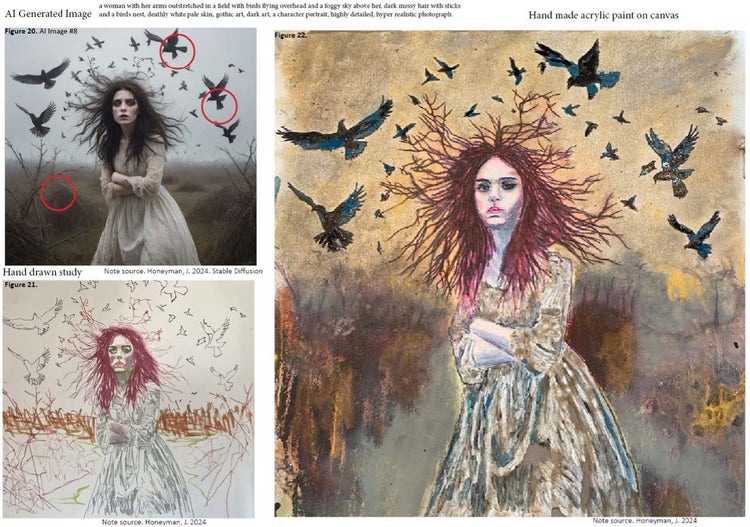
Figure 15: Artwork #1 (Honeyman, 2024).
Prompt: a woman with her arms outstretched in a field with birds flying overhead and a foggy sky above her, dark messy hair with sticks and a bird’s nest, deathly white pale skin, gothic art, dark art, a character portrait, highly detailed, hyper realistic photograph
Issues: Artificial intelligence did not adhere to the prompt; the piles of sticks and crossed arms were not part of the brief. The birds approach symbols and some of them have too many wings.
Outcome: The handmade work adds in a much more emotive, expressive visual rhetoric and this forms a visual consistency which allows the objects to make more sense pictorially. For example, the birds are no longer read as symbols of birds and the issue with too many wings is resolved due to the expressive style of the work. I would argue that this is due to a cultural awareness of expressive art forms and that painting does not need to be photoreal. The emotive visual language of the handmade work overwrites the artificial intelligence hallucination errors of the source material.
The source material begins with the lack of groundedness and visual rhetoric which tended to occur in my previous techniques of using photoshopped images.
There is some minor value of artificial intelligence image in the creative process was that of an authorless image as a source material. The scholars Yang et al (2023) have described these types of artificial intelligence generated images as synthetic data and when they appear online, allows for an image which, while fake or inauthentic, is also, conversely, original and un-attributable. The value is limited when using such an image as a source material for handmade artwork due to the original digital image having little direct relation to the creation of a physical artefact, which is altered by the process of making.
Artwork #2
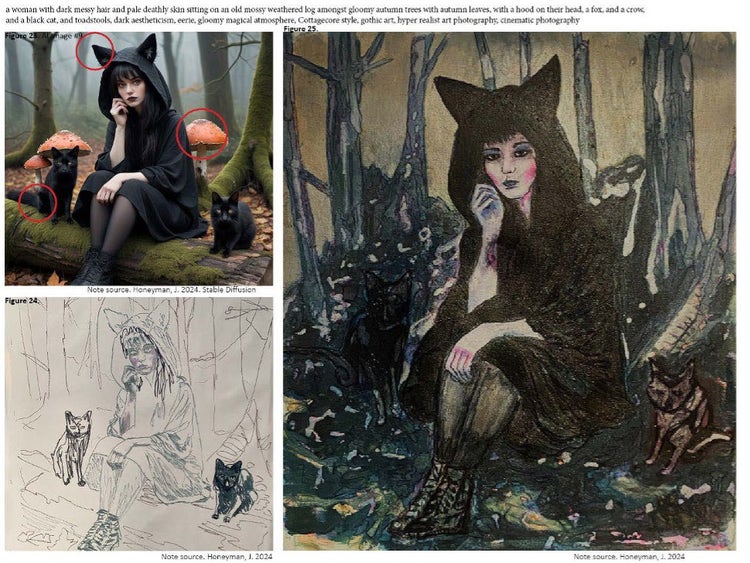
Figure 16: Artwork #2 (Honeyman, 2024).
Prompt: a woman with dark messy hair and pale deathly skin sitting on an old mossy weathered log amongst gloomy autumn trees with autumn leaves, with a hood on their head, a fox, and a crow, and a black cat, and toadstools, dark aesthetics, eerie, gloomy, magical atmosphere, Cottagecore style, gothic art, hyper realistic photography, cinematic photography.
Issues: The fox and crow don’t make an appearance, rather two black cats, and some oversized toadstools. The woman’s hood includes the ears of what might be a dog or cat.
Outcome: There is a visual consistency in a kind of magic realism vibe. The giant toadstools were probably the main example of artificial intelligence hallucinations. The handmade work was like the previous example, more expressive and emotive than the artificial intelligence image. So, despite the handmade work not being an attempt at realism, the visual rhetoric is stronger since there is an emotive intent in the creation of the work and the way a viewer responds to the work. Artificial intelligence is unable to achieve this due to its lack of groundedness and lack of intent.
Even though these two images have relatively few artificial intelligence hallucinations, the images lack emotive connection. The artificial intelligence image provided some creative value in the way it hallucinated ears on the figure’s hooded clothing, which provided a visual consistency with the ears of the cats. To some extent the composition was also useful with the two cats and the figure arranged in a triangular layout – which further echoes the triangles of the ears. However, the reality is that this image was one out of over fifty outputs with the same prompt, and most did not include the added ears or composition. Thus, it is fair to say that artificial intelligence did not produce the image with intent, rather it was the result of an algorithmic lottery.
Artwork #3
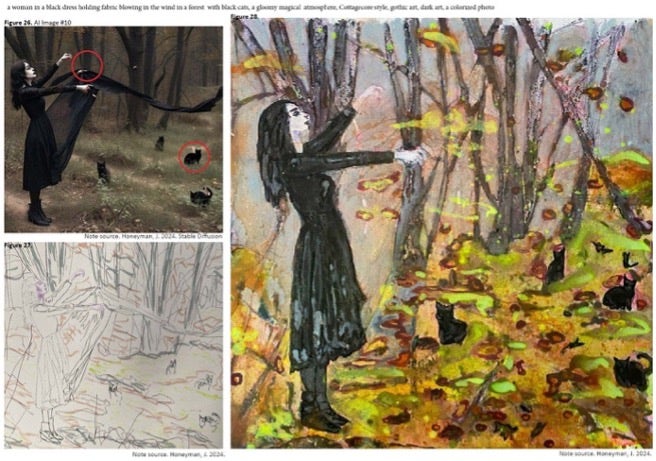
Figure 17: Artwork #3 (Honeyman, 2024).
Prompt: a woman in a black dress holding fabric in the wind in a forest with black cats, a gloomy magical atmosphere, Cottagecore style, gothic art, a colourised photograph.
Issues: The artificial intelligence image here hallucinated in the extra limb and the representation of the cats as symbols in an otherwise realistic scene. This visual inconsistency again lacked emotive and expressive impact.
Outcome: The handmade deviated from the artificial intelligence source in terms of being much more expressive and altering the composition of the background in a flatter, abstracted way. In this way the cats are fine as symbols.
Artwork #4
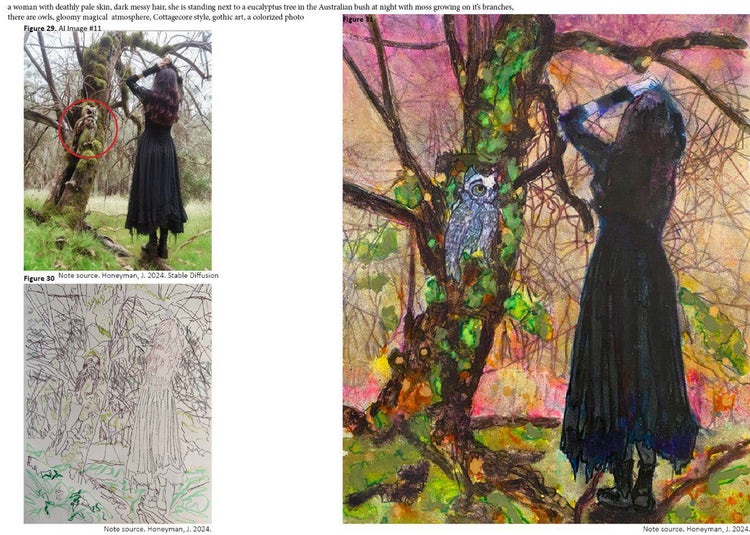
Figure 18: Artwork #4 (Honeyman, 2024).
Prompt: a woman with deathly pale skin, dark messy hair, she is standing next to a eucalyptus tree in the Australian bush at night with moss growing on its branches, there are owls, gloomy magical atmosphere, Cottagecore style, gothic art, a colourised photograph.
This example used a direct photo as a seed image for artificial intelligence where it was prompted to add in an owl.
Issues: There is only a very minor hallucination, with the slightly odd owl which appears to be growing out of the tree bark. Because it has a photo as a visual input the artificial intelligence image has improved visual consistency and rhetoric. It feels like it is about something and the elements in the object are intentional.
Outcome: The handmade work approaches this with a much more illustrative style which heightens the magical realism aspect of the artificial intelligence image.
Artwork #5
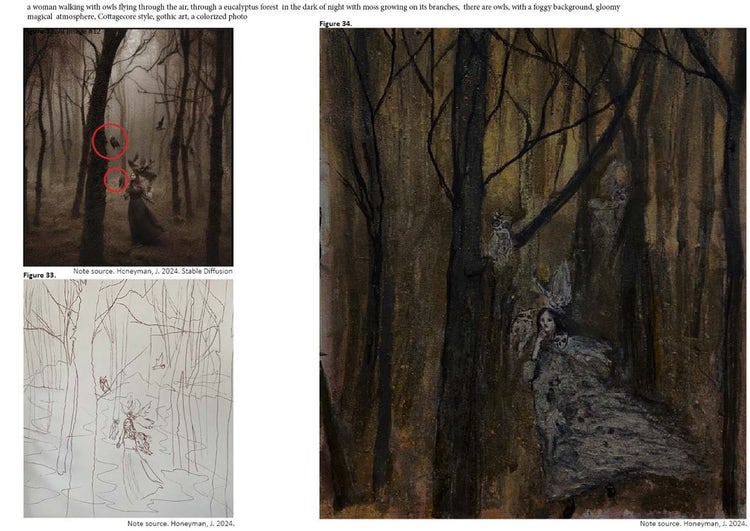
Figure 19: Artwork #5 (Honeyman, 2024).
Prompt: a woman walking with owls flying through the air, through a eucalyptus forest in the dark of night with moss growing on its branches, there are owls, with a foggy background, gloomy magical atmosphere, Cottagecore style, gothic art, a colourised photograph.
Issues: The hallucination is very pronounced with the birdlike creatures (in the prompt they are supposed to be owls flying in a forest).
The owls become less then symbols and almost abstract apparitions. Some are floating in the air without even flying. The woman has become distorted and grotesques. This artificial intelligence image comes close to the hallucinations which occur in handmade art such as the Symbolist works of Odilon Redon. The owl without wings and the gloomy forest comes across as a nightmarish vision or dreamlike hallucination.
Outcome: The handmade work was more of a struggle here since the artificial intelligence image seemed to convey an expressive quality – even if this was paradoxically a result of artificial intelligence hallucinations.
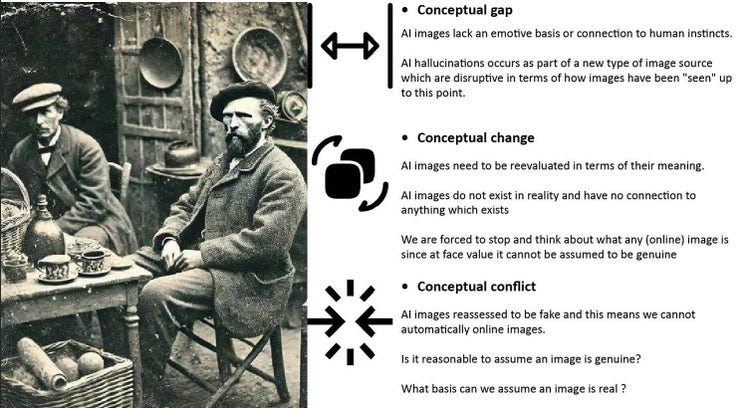
Figure 20: Van Gogh in a café (FromUnknown (AI), 2024. Facebook).
The image in Figure 20 provides a compelling example of one that was recently doing the rounds on social media. It was captioned as being a photo of Van Gogh sitting in a bakery at the turn of the century. Most people who commented thought it a legitimate old photo of a famous artist.
However, anyone with art history knowledge or an interest in Van Gogh would know that there is only one authentic photo of Van Gogh in existence that captures him as a young man. A newly found photographic image of Van Gogh would be an extraordinary occurrence, and most unlikely to surface on social media in the first instance. In any case, close examination of the image highlights artificial intelligence hallucinations in the chair legs, rendering the chair as unlikely to function in reality. There is also something perplexing about the proportions of the artificial intelligence’s version of Vincent’s head.
Conclusion
To conclude, there must be consideration given to the conceptual disruption of artificial intelligence images in terms of the changing ways images are viewed, due to the lack of visual rhetoric and emotive intent in the resulting images. There is a conceptual gap where artificial intelligence images lack an emotive basis or connection to human instincts. Artificial intelligence hallucinations occur as part of a new type of image source, which are “disruptive” in terms of how images have been "seen" up to this point. Conceptual change occurs since artificial intelligence images need to be re-evaluated in terms of their meaning. Artificial intelligence images are not part of the real world and have no connection to anything tangible. We are increasingly forced to stop and consider what an online image is, since, at face value, it cannot be assumed to be genuine. This creates conceptual conflict, as humans are now aware that we cannot automatically trust online images. Is it reasonable to assume an image is genuine? And, on what basis can we assume an image is real?
Artificial intelligence image generators provoke conceptual disruption across the social and personal layers. The greatest conceptual disruption occurs at the level of creativity. Image makers not only need to reassess how artificial intelligence is changing the nature of image creation, but also the language of visual rhetoric, the idea of errors, and the visual mistakes that occur when the human vs algorithmic machine are in conflict. The conceptual disruption goes beyond the immediate creative output; it also impacts both the intended audience and the type of audience on social media who will scroll past images without checking sources or authorship. The impact of this disruption on image makers is both potentially an ethical violation of privacy, and a questioning of authenticity.
The conceptual disruption also impacts how creativity itself is perceived. Formally, image creation was a combination of skillsets, passion, talent, ambition, and imagination. As artificial intelligence image generators reduce this to a simple equation of supply and demand. An image is required to fulfill a role, for example, the need for an illustration in a commercial advertisement. Artificial intelligence image generators can effortlessly generate an image to satisfy the requirements of the brief, while formally an illustrator or photographer would have produced the image. A simple text prompt into artificial intelligence image generators software and the job is done for little cost, the resultant image may have flaws and bias, and will certainly be devoid of authenticity, it will also be authorless, lacking in personalised intention, cultural meanings, visual rhetoric and tangible creativity.
References
Atzmon, L. (2006). Dream work: The art and science of Fin de Siècle fantasy imagery [Doctoral dissertation, Middlesex University].
Baker, S., & Kanade, T. (2000). Hallucinating faces. In Proceedings Fourth IEEE International Conference on Automatic Face and Gesture Recognition (Cat. No. PR00580) (pp. 83–88). IEEE.
Berman, G. (1970). The paradox of Odilon Redon. *Konsthistorisk Tidskrift/Journal of Art History, 39*(1–4), 70–79.
Cambridge University Press. (n.d.). Disruption. In Cambridge Dictionary. Retrieved June 23, 2024.
Christensen, C. M., Raynor, M. E., & McDonald, R. (2015, December). What is disruptive innovation? Harvard Business Review, 1.
Coeckelbergh, M. (2023). The work of art in the age of AI image generation: Aesthetics and human-technology relations as process and performance. *Journal of Human-Technology Relations, 1*, 1–13.
Cole, W. R. (2024). Beyond deepfakes: Synthetic moving images and the future of history. Journal of Information Warfare, 23(1).
Dingli, A., & Seychell, D. (2015). The new digital natives. JB Metzler: Stuttgart, Germany.
Glaveanu, V. P., & Kaufman, J. C. (2019). The Cambridge Handbook of Creativity (2nd ed.). Cambridge University Press.
Gorska, A. M., & Jemielniak, D. (2023). The invisible women: uncovering gender bias in AI-generated images of professionals. Feminist Media Studies, 23(8), 4370-4375.
Gunjal, A., Yin, J., & Bas, E. (2024, March). Detecting and preventing hallucinations in large vision language models. In Proceedings of the AAAI Conference on Artificial Intelligence (Vol. 38, No. 16, pp. 18135–18143).
Halperin, B., & Lukin, S. (2024). Artificial dreams: Surreal visual storytelling as inquiry into AI 'hallucination'. In Proceedings of the 2024 ACM Designing Interactive Systems Conference (pp. 619–637).
Han, Z., Bai, Z., Mei, H., Xu, Q., Zhang, C., & Shou, M. Z. (2024). Skip\n: A simple method to reduce hallucination in large vision-language models. arXiv preprint arXiv:2402.01345.
Hopster, J. (2021). What are socially disruptive technologies? Technology in Society, 67, 1-8.
Hopster, J., Brey, P., Klenk, M., Löhr, G., Marchiori, S., Lundgren, B., & Scharp, K. (2023). Conceptual disruption and the ethics of technology. In I. van de Poel et al., (Eds.), Ethics of socially disruptive technologies: An introduction (pp. 141-162). Open Book Publishers.
Hutson, J., & Harper-Nichols, M. (2023). Generative AI and algorithmic art: Disrupting the framing of meaning and rethinking the subject-object dilemma. Global Journal of Computer Science and Technology, 23(D1), 55–61.
Hyung-Kwon, K., Park, G., Jeon, H., Jo, J., Kim, J., & Seo, J. (2023). Large-scale text-to-image generation models for visual artists’ creative works. arXiv.
Kishnani, D. (2025). The Uncanny Valley: An Empirical Study on Human Perceptions of AI-Generated Text and Images (Doctoral dissertation, Massachusetts Institute of Technology).
Kilkki, K., Mäntylä, M., Karhu, K., Hämmäinen, H., & Ailisto, H. (2018). A disruption framework. Technological Forecasting and Social Change, 129, 275–284.
Leone, M. (2024). Semiotics of the black box: On the rhetorics of algorithmic images. Visual Communication, 23(3), 426–451.
Levina, M. (2017). Disrupt or die: Mobile health and disruptive innovation as body politics. Television & New Media, 18(6), 548–564.
Löhr, G. (2023). Conceptual disruption and 21st century technologies: A framework. Technology in Society, 74, 1–9.
Lu, P., Huang, L., Wen, T., & Shi, T. (2024). Assessing visual hallucinations in vision-enabled large language models. Journal of AI Research, 12(3), 45–60.
Maleki, N., Padmanabhan, B., & Dutta, K. (2024). AI hallucinations: A misnomer worth clarifying. In 2024 IEEE Conference on Artificial Intelligence (CAI) (pp. 133–138).
Marchiori, S., & Scharp, K. (2024). What is conceptual disruption? Ethics and Information Technology, 26(1), 1–14.
Mathieu, P. L. (1990). The Symbolist Generation, 1870-1910. Skira.
Mazzone, M., & Elgammal, A. (2019, February). Art, creativity, and the potential of artificial intelligence. Arts, 8(1), 26.
Merriam-Webster. (n.d.). Disruption. In Merriam-Webster.com dictionary. Retrieved June 23, 2024.
Meyer, R. (2023). The new value of the archive: AI image generation and the visual economy of style. The Interdisciplinary Journal of Image Sciences, 37(1), 100–111.
Muzumdar, P., Cheemalapati, S., RamiReddy, S. R., Singh, K., Kurian, G., & Muley, A. (2025). The dead internet theory: A survey on artificial interactions and the future of social media. arXiv preprint arXiv:2502.00007.
Neggars, O. (2023, November 7). Professional use of AI image generators: A study about implications for the practices of professionals using AI image generators [Unpublished manuscript]. DSpace.
Pather, S., Govender, R., & Scholtz, D. (2024). Shifting mindsets from conference to (un)conference: A collaborative reflective perspective on conceptual disruption. Critical Studies in Teaching and Learning, 12(SI1), 62-78.
Rathke, E. (2007). Imagination and reality; Odilon Redon and photography. In Redon, O., Stuffmann, M., Hollein, M., & Schirn, Odilon Redon: as in a dream; (in conjunction with the exhibition “Odilon Redon”, Schirn Kunsthalle Frankfurt, January 28–April 29, 2007), (pp. 51–57). Kunsthalle Frankfurt. Hatje Cantz.
Tavory, I., & Fine, G. A. (2020). Disruption and the theory of the interaction order. Theory and Society, 49(3), 365–385.
Tedre, M., & Vartiainen, H. (2023). How text-to-image generative AI is transforming mediated fiction. Authorea Preprints.
Van de Poel, I., Hermann, J., Hopster, J., Lenzi, D., Nyholm, S., Taebi, B., & Ziliotti, E. (2023). Ethics of socially disruptive technologies: An introduction. Open Book Publishers.
Voigts, E. (2021). Algorithms, artificial intelligence, and posthuman adaptation: Adapting as cultural technique. Adaptation, 14(2), 289–308.
Vollmer, H. (2013). Confronting disruptions: The nexus of social situations. In The sociology of disruption, disaster and social change: Punctuated cooperation (pp. 1–27). Cambridge University Press.
Wingström, R., Hautala, J., & Lundman, R. (2022). Redefining creativity in the era of AI: Perspectives of computer scientists and new media artists. Creativity Research Journal, 36(2), 177–193.
Yang, Y. (2025). Racial bias in AI-generated images. AI & SOCIETY, 1-13.
Yang, Z., Zhan, F., Liu, K., Xu, M., & Lu, S. (2023). AI-generated images as data source: The dawn of synthetic era. arXiv preprint arXiv:2310.01830.
Yin, J., & Bas, E. (2024). Hallucination mitigation in multimodal AI systems. arXiv.
Zhou, M., Abhishek, V., Derdenger, T., Kim, J., & Srinivasan, K. (2024). Bias in generative AI. arXiv preprint arXiv:2403.02726.
About the author
Josh Honeyman is a visual artist and designer from the Blue Mountains. He holds degrees in Fine Arts from the University of NSW and Design from Western Sydney University. He is currently completing a Master of Research at Western Sydney University, exploring how contemporary imagery echoes Fin de Siècle themes of nature escapism and otherworldliness.
He has held 14 solo gallery exhibitions since 1996 and is aiming to begin a PhD in 2026.